
HVAC Terms Every Homeowner Should Know
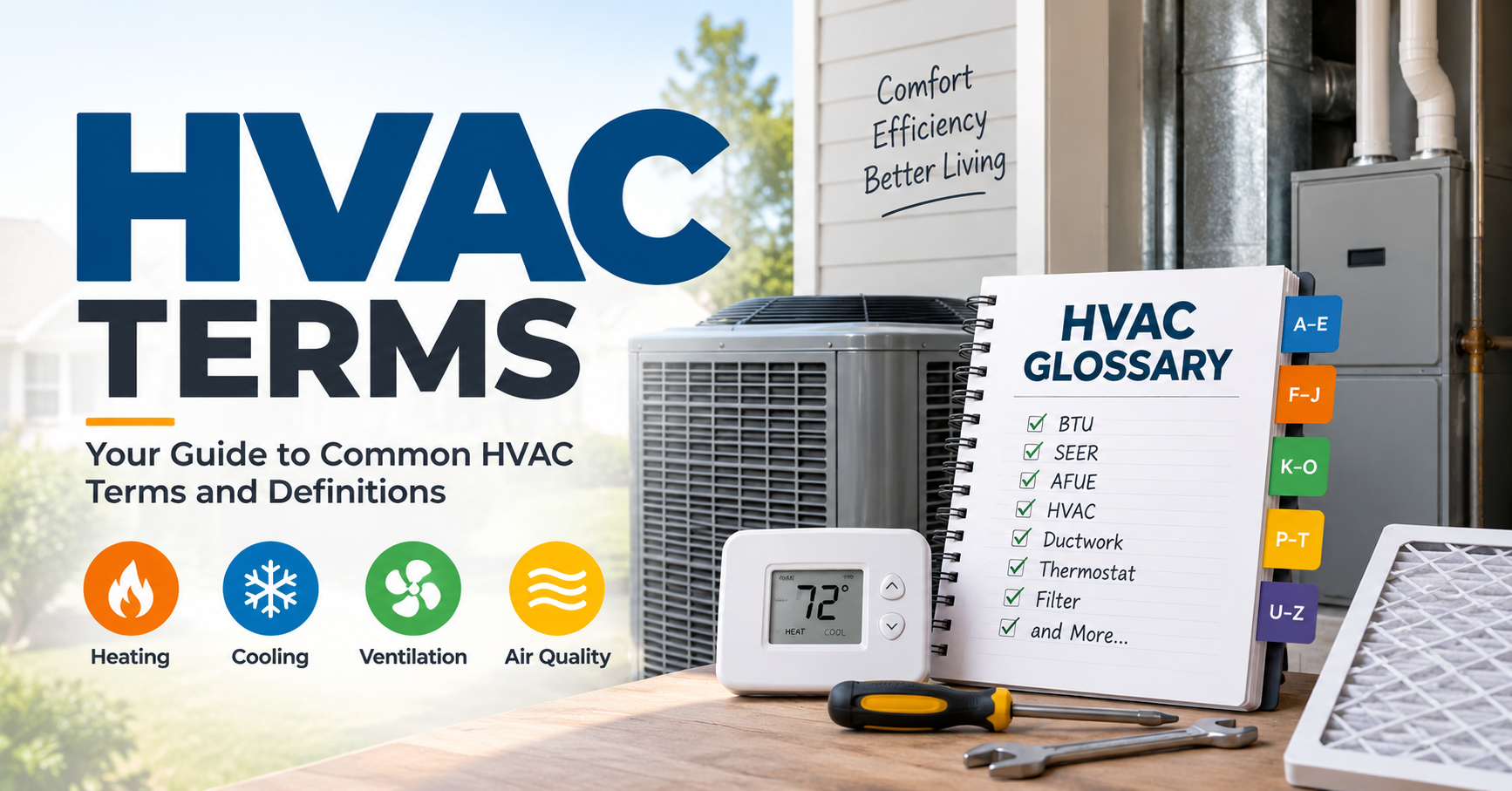
HVAC terms can sound confusing when you’re talking to a contractor, comparing equipment, or trying to understand a repair. Knowing the most common terms makes it easier to understand how your heating and cooling system works and what a technician is recommending.
This guide explains the most important HVAC terms in plain English, from BTU and SEER2 to MERV, CFM, heat pumps, refrigerant, and short cycling.
What Does HVAC Mean?
HVAC stands for Heating, Ventilation, and Air Conditioning, which covers the systems that heat, cool, and move air through your home.
A typical HVAC system may include a furnace, air conditioner, heat pump, air handler, thermostat, ductwork, and air filter.
Each component has a different job, but they work together to keep your home comfortable.
Basic HVAC Terms Homeowners Should Know
Understanding the basic equipment terms is a good starting point because these are the components you are most likely to hear about during HVAC maintenance, repair, or replacement.
What Is an HVAC System?
An HVAC system is a group of heating, cooling, and air-moving components that control indoor temperature and air circulation.
Depending on your home, your HVAC system may use:
- A furnace for heating
- An air conditioner for cooling
- A heat pump for heating and cooling
- An air handler to circulate air
- Ductwork to distribute air
- A thermostat to control temperature
- Filters to remove airborne particles
The exact setup depends on your home’s size, climate, fuel source, and equipment.
What Is a Furnace?
A furnace is a heating system that warms air and distributes it throughout the home.
Gas furnaces burn fuel to produce heat, while electric furnaces use electric heating elements.
A blower then moves the heated air through the home’s ductwork and into individual rooms.
What Is an Air Conditioner?
An air conditioner removes heat from indoor air and releases that heat outdoors to cool the home.
The main components include the compressor, condenser coil, evaporator coil, expansion device, blower, and refrigerant.
Unlike a furnace, an air conditioner does not create cold air. It removes heat from the air inside your home.
What Is a Heat Pump?
A heat pump transfers heat between your home and the outdoors to provide both heating and cooling.
During cooling, it moves heat from inside your home to the outdoors. During heating, it reverses the process and brings heat from outside into the home. If your heat pump is having trouble providing heat, learn more about heat pump not heating.
Heat pumps can reduce the need for separate heating and cooling equipment, although the best system depends on the home and local climate.
What Is an Air Handler?
An air handler is the indoor unit that circulates and, depending on the system, conditions air throughout the home.
An air handler commonly contains a blower, filter area, evaporator coil, and other components.
Heat pump systems often use an air handler for indoor air circulation and heating or cooling.
What Is an Evaporator Coil?
An evaporator coil is the indoor coil that absorbs heat from the home’s air during the cooling process.
Warm indoor air passes over the coil, and refrigerant inside the coil absorbs heat.
A dirty, frozen, or damaged evaporator coil can reduce cooling performance and airflow.
What Is a Condenser Coil?
A condenser coil is the outdoor coil that releases heat absorbed from inside the home.
During normal air conditioner operation, refrigerant carries heat from the indoor evaporator coil to the outdoor unit.
The outdoor fan moves air across the condenser coil to help release that heat.
What Is a Compressor?
A compressor is the component that circulates refrigerant through an air conditioner or heat pump and raises the refrigerant’s pressure.
It is one of the most important components in the refrigeration cycle.
Because compressor replacement can be expensive, unusual noises, poor cooling, or repeated system problems should be professionally diagnosed.
What Is Refrigerant?
Refrigerant is the fluid that moves heat through an air conditioner or heat pump.
It changes between liquid and vapor as it moves through the system and absorbs or releases heat during the process.
If refrigerant levels are low, the system may have a leak or another problem. Refrigerant service should be performed by a qualified HVAC professional.
What Is a Thermostat?
A thermostat is the control that tells your HVAC system when to heat or cool your home.
Basic thermostats allow you to set a temperature, while programmable and smart thermostats can automatically adjust temperatures according to a schedule.
A thermostat problem can sometimes cause an HVAC system to run incorrectly or not run at all.
HVAC Efficiency Terms
Efficiency ratings help homeowners compare HVAC equipment and understand how much energy a system may use.
What Is SEER2?
SEER2 is a seasonal efficiency rating used for air conditioners and heat pumps in cooling mode.
A higher SEER2 rating generally indicates greater cooling efficiency under the rating conditions. Our guide to SEER2 ratings explains how this efficiency rating can help when comparing HVAC systems.
However, efficiency is only one factor when choosing equipment. System size, installation quality, ductwork, climate, and how the equipment is operated also affect actual energy use.
What Is AFUE?
AFUE stands for Annual Fuel Utilization Efficiency and measures how efficiently a fuel-burning furnace converts fuel into usable heat over a heating season.
For example, a furnace with a 90% AFUE rating converts about 90% of its fuel energy into heat under the rating conditions, with the remainder lost.
AFUE applies primarily to furnaces and other fuel-burning heating equipment.
What Is HSPF2?
HSPF2 stands for Heating Seasonal Performance Factor 2 and measures the heating efficiency of heat pumps over a heating season.
A higher HSPF2 rating generally indicates better heating efficiency under the test conditions.
When comparing heat pumps, look at both their cooling and heating efficiency ratings.
What Is COP in HVAC?
COP, or coefficient of performance, compares the amount of heating or cooling produced with the energy used by the system.
It is commonly used when discussing heat pumps and other heating or cooling equipment.
Unlike a percentage-based rating, COP is expressed as a ratio.
HVAC Airflow and Ventilation Terms
Airflow plays a major role in HVAC performance because your system needs to move the right amount of air through the home.
What Is CFM?
CFM stands for cubic feet per minute and measures the volume of air moving through an HVAC system.
Technicians use CFM when evaluating airflow through ducts, vents, blowers, and other parts of an HVAC system.
Too little or too much airflow can affect comfort and system performance.
What Is Static Pressure?
Static pressure is the resistance that air encounters as it moves through an HVAC system.
High static pressure can occur because of restrictive filters, blocked ducts, undersized ductwork, closed vents, or other airflow restrictions.
Excessive static pressure can make the system work harder and may contribute to poor comfort or equipment problems.
What Is a Return Vent?
A return vent is an opening that pulls indoor air back into the HVAC system.
The system then filters and conditions the air before sending it back through the supply ducts.
Keep return vents clear of furniture, curtains, boxes, and other objects so the system can move air properly.
What Is a Supply Vent?
A supply vent is an opening that delivers conditioned air from the HVAC system into a room.
Supply vents are usually located on walls, floors, or ceilings.
Closing too many supply vents can affect airflow and system performance, particularly if the duct system was not designed for that change.
What Is Ductwork?
Ductwork is the network of passages that carries heated or cooled air between the HVAC equipment and rooms in the home.
Ducts can be made from materials such as sheet metal, fiberglass, or flexible duct material.
Leaks, poor insulation, crushed sections, disconnected joints, and restrictions can reduce HVAC efficiency and comfort. Learn the signs you need air duct sealing if you suspect your ductwork is leaking.
What Is Ventilation?
Ventilation is the process of bringing outdoor air into a building and removing indoor air.
Ventilation is different from heating and cooling because its main purpose is air exchange rather than temperature control.
Proper ventilation can help manage indoor pollutants, odors, moisture, and stale air.
HVAC Filter and Indoor Air Quality Terms
Your HVAC filter and ventilation system affect both equipment performance and indoor air quality.
What Is MERV?
MERV stands for Minimum Efficiency Reporting Value and is a rating used to describe how effectively an air filter captures certain airborne particles.
Higher MERV ratings generally indicate greater filtration efficiency. For more information, see our MERV rating guide.
However, a higher MERV filter is not automatically better for every HVAC system. A filter that is too restrictive for the system can reduce airflow.
Always consider your HVAC manufacturer’s recommendations and the system’s airflow requirements when selecting a filter.
What Is HEPA?
HEPA stands for High-Efficiency Particulate Air, a type of filtration designed to capture a very high percentage of small airborne particles under specified test conditions. Learn more about HEPA filters and how they can help improve indoor air filtration.
HEPA filtration is common in applications where high particle removal is important.
A standard residential HVAC system may not be designed to accommodate a HEPA filter directly, so adding one may require a properly designed filtration system.
What Is Indoor Air Quality?
Indoor air quality, or IAQ, refers to the condition of the air inside a building. Our indoor air quality services can help address common indoor air concerns through proper filtration, ventilation, humidity control, and other solutions.
Factors that can affect IAQ include:
- Airborne particleshttps://summersphc.com/bloomington/services/indoor-air/
- Dust
- Allergens
- Indoor humidity
- Outdoor air exchange
- Combustion pollutants
- Odors
- Household chemicals
If you’re noticing potential problems with your home’s air, learn about the signs of poor indoor air quality.
HVAC filtration and ventilation can help, but they are only part of good indoor air quality management.
What Is Relative Humidity?
Relative humidity is the amount of moisture in the air compared with the maximum amount of moisture the air can hold at that temperature.
High humidity can make a home feel warmer and can contribute to moisture-related problems.
Very low humidity can cause dry skin, irritated airways, static electricity, and other comfort issues. If your home feels unusually dry during colder months, see our guide to home too dry in winter.
Common HVAC Repair and Service Terms
These terms often come up when a technician is diagnosing an HVAC problem.
What Is Preventive HVAC Maintenance?
Preventive HVAC maintenance is routine service performed to keep the system operating safely and efficiently and to identify developing problems.
Maintenance may include:
- Inspecting system components
- Checking electrical connections
- Checking airflow
- Inspecting coils
- Checking filters
- Cleaning accessible components
- Checking operating performance
- Inspecting safety controls
The exact maintenance tasks depend on the type of HVAC system.
What Is an HVAC Tune-Up?
An HVAC tune-up is a scheduled inspection and maintenance service intended to check system operation and address developing issues.
A tune-up is different from a repair because maintenance focuses on preventing or identifying problems, while repair addresses an existing fault. For furnace maintenance specifically, our furnace tune-up checklist covers important items homeowners should know about.
What Is a Refrigerant Leak?
A refrigerant leak is a loss of refrigerant from an air conditioner or heat pump’s sealed refrigeration system.
Common warning signs can include reduced cooling, ice on refrigerant lines or coils, longer run times, or poor system performance.
Adding refrigerant without finding the source of a leak does not fix the underlying problem.
What Is Short Cycling?
Short cycling happens when an HVAC system turns on and off more frequently than it should.
Possible causes include:
- Incorrect system sizing
- Restricted airflow
- Thermostat problems
- Refrigerant issues
- Dirty components
- Equipment problems
- High indoor heat loads
Short cycling can increase wear and reduce comfort, so repeated cycling should be checked by a professional.
What Is a Blower Motor?
A blower motor powers the fan that moves air through the HVAC system and ductwork.
A failing blower motor can cause weak airflow, unusual noises, overheating, or a complete loss of air movement.
What Is an HVAC Capacitor?
An HVAC capacitor is an electrical component that helps certain motors start and run properly.
Air conditioners and heat pumps may use capacitors for components such as the compressor and fan motors.
A failed capacitor can prevent a motor from starting or cause it to operate improperly.
Because capacitors can hold an electrical charge, they should be handled by a qualified technician.
What Is an HVAC Contactor?
A contactor is an electrical switch that controls high-voltage power to components such as an air conditioner’s compressor and outdoor fan motor.
The thermostat sends a low-voltage control signal, which causes the contactor to connect or disconnect the higher-voltage circuit.
Contactor problems can cause an outdoor unit to fail to start or operate correctly.
Heating Terms Homeowners Should Know
Knowing these heating terms can help you understand common furnace problems and service recommendations.
What Is a Heat Exchanger?
A heat exchanger transfers heat from combustion gases to the air being heated in a furnace while keeping the combustion gases separated from the indoor air.
A damaged heat exchanger can create a serious safety concern because combustion gases may enter the home’s air stream.
Heat exchanger problems require professional inspection.
What Is a Pilot Light?
A pilot light is a small, continuously burning flame used to ignite the main burner in some older gas appliances.
Many modern furnaces use electronic ignition instead, so they do not have a continuously burning pilot light.
What Is a Flame Sensor?
A flame sensor is a safety component in many gas furnaces that confirms the burner flame is present.
If the system cannot confirm a flame, it may shut off the gas supply as a safety measure.
A dirty or malfunctioning flame sensor can cause a furnace to start and then shut down.
What Is a Limit Switch?
A limit switch is a furnace safety device that helps prevent the system from operating at excessively high temperatures.
If the furnace becomes too hot, the limit switch can shut down the burner.
A homeowner should never bypass a limit switch because doing so can remove an important safety protection.
HVAC Sizing and Installation Terms
Proper sizing and installation are just as important as the equipment itself.
What Is an HVAC Load Calculation?
An HVAC load calculation determines how much heating and cooling capacity a home needs.
The calculation can consider factors such as:
- Home size
- Insulation
- Windows
- Building orientation
- Local climate
- Air leakage
- Occupancy
- Other heat gains and losses
A proper load calculation is more reliable than choosing an HVAC system based only on square footage.
What Is BTU?
BTU stands for British thermal unit and is a unit used to describe the amount of heat energy involved in heating and cooling.
In HVAC, BTU ratings are commonly used to describe heating capacity and cooling capacity.
A larger BTU rating does not automatically mean better performance. An oversized HVAC system can cycle too frequently and may not provide the comfort or humidity control you expect.
What Is HVAC Tonnage?
HVAC tonnage refers to an air conditioner’s or heat pump’s cooling capacity, not its physical weight.
One ton of cooling capacity equals approximately 12,000 BTUs per hour.
For example, a 3-ton air conditioner has a nominal cooling capacity of about 36,000 BTUs per hour.
System size should be selected using a proper load calculation rather than guessing from the home’s square footage.
What Is Ductless HVAC?
Ductless HVAC is a heating and cooling system that does not require traditional central ductwork.
A ductless mini-split typically includes an outdoor unit connected to one or more indoor units.
Ductless systems can work well for additions, garages, individual rooms, older homes without ductwork, and spaces where extending existing ducts is impractical. If you’re considering a mini-split, learn how long mini-split systems last before choosing a system.
HVAC Terms Related to Modern Systems
Newer HVAC systems use technology that can improve comfort, efficiency, and temperature control.
What Is a Smart Thermostat?
A smart thermostat is a connected thermostat that can provide features such as scheduling, remote control, temperature monitoring, and system alerts.
Some models can learn usage patterns or adjust operation based on programmed settings. You can also learn more about smart thermostat cooling settings and how they can help manage indoor temperatures.
Before installing one, make sure it is compatible with your HVAC system.
What Does Variable-Speed Mean?
Variable-speed refers to a motor or compressor that can operate at different speeds instead of simply running at one fixed speed.
Variable-speed equipment can adjust output more closely to the home’s heating or cooling demand.
This can improve temperature consistency and reduce unnecessary cycling when the system is properly designed and installed.
What Is Two-Stage HVAC?
Two-stage HVAC equipment can operate at two different capacity levels rather than using only one.
The system can run at a lower capacity when demand is moderate and use higher capacity when more heating or cooling is needed.
This can improve comfort and reduce frequent on-and-off operation in suitable applications.
What Is Inverter Technology?
Inverter technology allows certain HVAC compressors to adjust their operating speed instead of constantly switching between full output and off.
This lets the system vary its capacity based on demand.
Inverter-driven heat pumps and air conditioners can provide more consistent temperature control and may use less energy under suitable operating conditions.
HVAC Terms: Quick Homeowner Glossary
Here is a quick reference for some of the most useful HVAC terms:
| HVAC Term | Simple Meaning |
| HVAC | Heating, Ventilation, and Air Conditioning |
| BTU | Unit used to describe heating or cooling capacity |
| CFM | Cubic feet of air moved per minute |
| SEER2 | Seasonal cooling efficiency rating |
| AFUE | Fuel-use efficiency rating for furnaces |
| HSPF2 | Seasonal heating efficiency rating for heat pumps |
| MERV | Air filter performance rating |
| HEPA | High-efficiency particle filtration |
| Static Pressure | Resistance to airflow |
| Refrigerant | Fluid that transfers heat in cooling systems |
| Compressor | Circulates and compresses refrigerant |
| Evaporator Coil | Indoor coil that absorbs heat |
| Condenser Coil | Outdoor coil that releases heat |
| Heat Pump | Transfers heat for heating and cooling |
| Air Handler | Indoor equipment that moves air |
| Short Cycling | Frequent HVAC starting and stopping |
| Load Calculation | Determines required heating and cooling capacity |
| Tonnage | Measure of nominal cooling capacity |
| Blower Motor | Moves air through the HVAC system |
| Thermostat | Controls the HVAC system based on temperature |
| Ductwork | Carries conditioned air through the home |
Which HVAC Terms Matter Most When Buying a New System?
The most important terms to understand when buying a new HVAC system are BTU, tonnage, SEER2, AFUE, HSPF2, load calculation, airflow, and HVAC system type.
Don’t choose a system based only on its efficiency rating or advertised capacity.
Ask the contractor:
- How was the system size determined?
- What is the equipment’s efficiency rating?
- Is the existing ductwork properly sized?
- Will the new system work with the current thermostat?
- What maintenance will the system require?
- What warranty is included?
- Is the equipment appropriate for the home’s heating and cooling needs?
A properly sized and installed system can perform better than a higher-rated system that is poorly matched to the home.
Which HVAC Terms Should Homeowners Know for Repairs?
The most useful repair terms include short cycling, refrigerant leak, blower motor, capacitor, contactor, flame sensor, limit switch, static pressure, and airflow.
Understanding these terms does not mean you should attempt the repair yourself.
Instead, they can help you understand what a technician is telling you.
For example, if a technician says your system has high static pressure, that means the airflow is encountering too much resistance. If they mention short cycling, the system is turning on and off too frequently.
Knowing the terminology can make repair conversations much easier.
What Are the Most Important HVAC Terms for Homeowners?
The most important HVAC terms for homeowners are the ones connected to system type, capacity, efficiency, airflow, filtration, maintenance, and repairs.
If you only remember a few, start with these:
- BTU: Heating or cooling capacity
- Tonnage: Nominal cooling capacity
- SEER2: Cooling efficiency
- AFUE: Furnace fuel efficiency
- MERV: Filter performance rating
- CFM: Airflow measurement
- Static pressure: Airflow resistance
- Refrigerant: Heat-transfer fluid
- Heat pump: Heating and cooling system that transfers heat
- Short cycling: Frequent system on/off operation
- Load calculation: Method used to determine the right system size
These terms cover many of the conversations homeowners have with HVAC contractors.
Need Help Understanding Your HVAC System?
HVAC terminology can be useful, but you don’t need to become an HVAC expert to make good decisions about your home.
If you’re dealing with poor airflow, frequent cycling, uneven temperatures, unusual noises, or an HVAC system that isn’t performing properly, a professional inspection can identify the underlying issue.
Contact [Company Name] today to schedule an HVAC inspection and get clear answers about your heating and cooling system.
[Schedule an HVAC Inspection]
FAQs About HVAC Terms
What does HVAC stand for?
HVAC stands for Heating, Ventilation, and Air Conditioning. It refers to the systems used to heat, cool, ventilate, and circulate air in a building.
What does BTU mean in HVAC?
BTU stands for British thermal unit and is commonly used to describe heating and cooling capacity. A higher BTU rating means greater nominal capacity, but the right capacity depends on the home’s actual heating or cooling load.
What does SEER2 mean?
SEER2 is a seasonal efficiency rating used for air conditioners and heat pumps in cooling mode. A higher SEER2 rating generally indicates greater cooling efficiency under the rating conditions.
What does MERV mean?
MERV stands for Minimum Efficiency Reporting Value and describes an HVAC filter’s ability to capture certain airborne particles. A higher MERV rating does not automatically mean a filter is right for every HVAC system.
What does CFM mean in HVAC?
CFM means cubic feet per minute and measures the volume of air moving through an HVAC system. Proper airflow is important for comfort and equipment performance.
What is the difference between a heat pump and an air conditioner?
A heat pump can provide both heating and cooling by moving heat in either direction, while a standard air conditioner primarily provides cooling.
What is HVAC tonnage?
HVAC tonnage describes an air conditioner’s or heat pump’s nominal cooling capacity. One ton equals approximately 12,000 BTUs per hour of cooling capacity.
What is short cycling?
Short cycling occurs when an HVAC system turns on and off more frequently than it should. It can be caused by problems such as incorrect sizing, restricted airflow, thermostat issues, or equipment faults.
What is static pressure in HVAC?
Static pressure is the resistance air encounters as it moves through an HVAC system. High static pressure can indicate airflow restrictions and may reduce system performance.
What is a good MERV rating for a home?
The right MERV rating depends on the HVAC system’s design and the manufacturer’s recommendations. A higher rating can provide more filtration, but a filter that is too restrictive can reduce airflow.
What does AFUE mean on a furnace?
AFUE stands for Annual Fuel Utilization Efficiency and measures how efficiently a fuel-burning furnace converts fuel into usable heat over a heating season.