

What Is MERV Rating? HVAC Filter Buying Guide
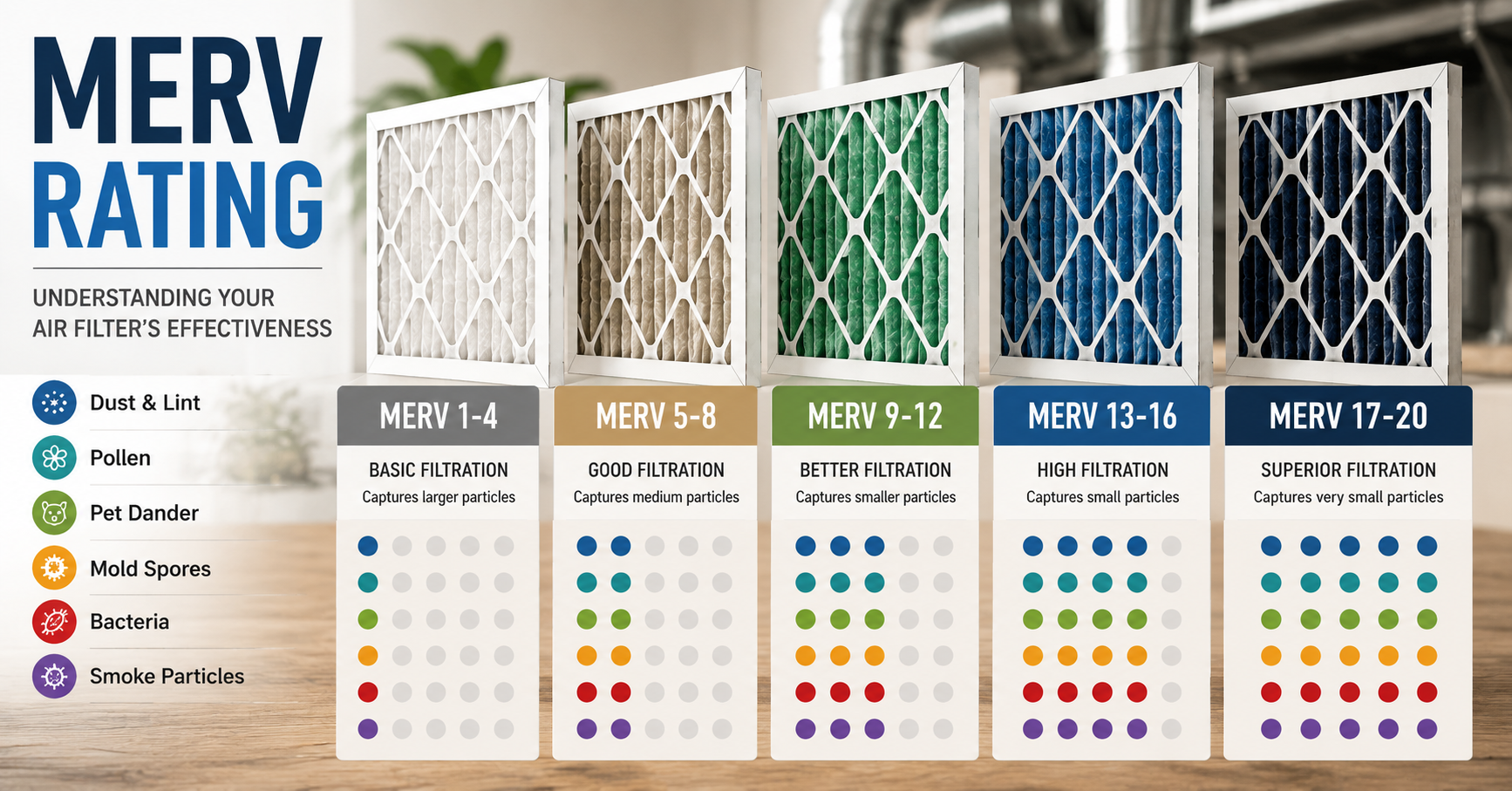
If you’ve ever bought an HVAC filter, you’ve probably noticed numbers like MERV 8, MERV 11, or MERV 13 on the package. These numbers tell you how well the filter captures different types of airborne particles.
MERV stands for Minimum Efficiency Reporting Value, and it measures how effectively an HVAC filter removes particles from the air. In general, a higher MERV rating means the filter can capture smaller particles.
But higher isn’t always better for every HVAC system. A high-efficiency filter can create more resistance to airflow, especially if your system isn’t designed for it.
This guide explains what MERV ratings mean, how common ratings compare, and how to choose the right HVAC filter for your home.
What Is a MERV Rating?
A MERV rating tells you how well an HVAC air filter captures airborne particles. MERV stands for Minimum Efficiency Reporting Value, and the rating is used to compare the filtration performance of different filters.
The MERV scale generally runs from 1 to 16. As the rating increases, the filter can capture smaller particles more effectively.
For example, a lower-MERV filter may catch larger particles such as dust and debris. A MERV 13 filter can capture a much higher percentage of smaller airborne particles.
One important point: MERV is not a simple percentage score. A MERV 13 filter does not mean it captures 13% of particles. Its efficiency is tested across specific particle-size ranges under standardized conditions.
The filter’s real-world performance can also vary based on its design, airflow, particle size, and how well it fits in the HVAC system.
So, when comparing HVAC filters, don’t look at the MERV number alone. Choose a rating that provides the filtration you need without restricting your HVAC system’s required airflow.
MERV Rating Chart
The MERV rating chart shows how filter efficiency increases as the MERV number goes up. Lower-rated filters provide basic filtration, while higher-rated filters capture smaller airborne particles more effectively.
| MERV Rating | Filtration Level | Common Use |
| MERV 1–4 | Basic | Basic or older HVAC systems |
| MERV 5–8 | Moderate | Many residential HVAC systems |
| MERV 9–12 | Higher | Homes that need stronger particle filtration |
| MERV 13–16 | High | Higher-efficiency filtration when the HVAC system can handle it |
A higher MERV rating generally means better particle filtration, but it can also increase airflow resistance. That’s why you shouldn’t choose a filter based on the MERV number alone.
For most homeowners, MERV 8, MERV 11, and MERV 13 are the ratings worth comparing. MERV 8 offers basic residential filtration, MERV 11 provides a higher level of filtration, and MERV 13 captures even smaller particles when the HVAC system is designed to handle it.
Quick tip: Check your HVAC manufacturer’s recommended MERV rating before moving to a higher-efficiency filter. The filter should provide good filtration without restricting the airflow your system needs.
What Is the Best MERV Rating for a Home?
For most homes, MERV 8 to MERV 11 is a practical range, while MERV 13 can provide better filtration if the HVAC system can handle it. There isn’t one MERV rating that works best for every home.
The right choice depends on your HVAC system, filter size and thickness, and what you want the filter to remove.
- MERV 8: A good choice for basic residential filtration and many standard HVAC systems.
- MERV 11: A step up when you want better filtration than MERV 8.
- MERV 13: A strong option for capturing smaller particles, but the HVAC system must be able to handle the filter’s airflow resistance.
ASHRAE recommends MERV 13 or higher when the HVAC system can accommodate it. That doesn’t mean every home should use MERV 13.
The best MERV rating is the highest-efficiency filter your HVAC system is designed to handle properly. Check your owner’s manual or the manufacturer’s specifications before upgrading to a higher MERV rating.
If you’re unsure, an HVAC professional can check the system’s airflow and filter requirements before you make the switch.
MERV 8 vs. MERV 11 vs. MERV 13
MERV 8, MERV 11, and MERV 13 differ mainly in how efficiently they capture smaller airborne particles and how much airflow resistance they may create. MERV 8 is a common choice for basic residential filtration, MERV 11 offers stronger filtration, and MERV 13 provides the highest filtration of the three when the HVAC system can handle it.
| Feature | MERV 8 | MERV 11 | MERV 13 |
| Filtration | Basic to moderate | Higher | High |
| Larger particles | Good | Good | Good |
| Smaller particles | Limited | Better | Better |
| Airflow resistance | Generally lower | Moderate | Can be higher |
| Best for | Standard filtration | Improved filtration | Higher particle filtration |
| HVAC compatibility | Common in residential systems | Check system requirements | Check system requirements carefully |
MERV 8
MERV 8 is a practical choice for many standard residential HVAC systems that need basic particle filtration.
It can capture common airborne particles such as dust and pollen. It also tends to have less airflow resistance than higher-efficiency filters, although the actual pressure drop depends on the filter’s design.
MERV 8 may make sense if you:
- Want basic household filtration
- Have a standard residential HVAC system
- Don’t have unusually high particle levels in your home
- Want to balance filtration and airflow
MERV 11
MERV 11 is a good middle-ground option if you want more filtration than MERV 8 without moving directly to MERV 13.
It captures smaller particles more effectively than MERV 8. This can make it worth considering for homes with pets, higher dust levels, or a greater need for particle filtration.
MERV 11 may make sense if you:
- Want stronger filtration than MERV 8
- Have pets
- Deal with higher levels of household dust
- Have an HVAC system rated for MERV 11
MERV 13
MERV 13 offers the strongest filtration of these three ratings and is a good option when your HVAC system can handle it.
It is more effective at capturing smaller airborne particles than MERV 8 and MERV 11. ASHRAE recommends MERV 13 or higher when the HVAC system can accommodate the filter.
MERV 13 may make sense if you:
- Want higher-efficiency particle filtration
- Are concerned about fine airborne particles
- Need stronger filtration for your household
- Have an HVAC system designed to handle MERV 13
However, don’t choose MERV 13 just because it has the highest number. A filter that fits physically may still create too much airflow resistance for an HVAC system that isn’t designed for it.
Which Is Better: MERV 8, 11, or 13?
MERV 13 provides the highest filtration, but MERV 8 or MERV 11 may be the better choice for some HVAC systems. The right filter is the one that gives you the filtration you need without restricting the airflow your system requires.
If you’re unsure which filtration option is right for your home, check the HVAC manufacturer’s recommended MERV rating or consider professional indoor air services to evaluate your home’s filtration and indoor air-quality needs.
What MERV Rating Should I Buy?
For most homes, MERV 8 is a practical starting point, while MERV 11 or MERV 13 may be better when you need stronger particle filtration, and your HVAC system can handle it. Your home’s conditions and the manufacturer’s filter recommendation should guide the final choice.
For a Typical Home
MERV 8 is usually a practical choice for basic filtration in a standard residential HVAC system.
It can capture common particles such as dust and pollen without the higher airflow resistance that some high-efficiency filters can create.
If you want stronger filtration, MERV 11 may be a good step up, provided your HVAC system is designed for it.
For Allergies
MERV 11 or MERV 13 can provide better filtration for smaller airborne particles than MERV 8, if your HVAC system can accommodate them.
A higher-efficiency filter can help reduce airborne particles that may contribute to indoor air-quality problems. For additional filtration options, see these air filters for allergy relief. EPA recommends MERV 13, or the highest MERV rating the system’s fan and filter track can accommodate, for people concerned about small particles.
Keep in mind that an HVAC filter is only one part of allergy control. It won’t remove allergens from surfaces, bedding, carpets, or other areas of the home.
For Pets
MERV 8 or MERV 11 is often a practical choice for homes with pets, while MERV 13 can provide stronger particle filtration if the HVAC system supports it.
Pets add hair, dander, and other particles to the indoor environment. A higher-MERV filter can capture more of the smaller airborne particles, but you still need regular cleaning and grooming to control pet-related debris.
For Dust
MERV 8 is usually enough for normal household dust, while MERV 11 or MERV 13 may be worth considering when dust levels are higher.
If your home gets dusty quickly or you’re dealing with construction or remodeling, a higher-efficiency filter may help capture more airborne particles.
Before upgrading, make sure your HVAC system can handle the filter without creating excessive airflow resistance.
For Smoke and Fine Particles
MERV 13 is generally a better choice than MERV 8 for capturing fine airborne particles from smoke, provided your HVAC system can handle it.
Smoke contains very small particles that lower-efficiency filters may not capture as effectively. A MERV 13 filter can provide better filtration than MERV 8 or MERV 11.
For heavy or ongoing smoke exposure, don’t rely on the HVAC filter alone. Other measures may also help improve your home’s indoor air quality. A properly sized portable air cleaner can provide additional particle removal in occupied rooms.
Quick MERV Buying Guide
| Your Situation | MERV Rating to Consider |
| Basic home filtration | MERV 8 |
| More filtration than MERV 8 | MERV 11 |
| Pets and higher dust levels | MERV 11 |
| Fine particles and smoke | MERV 13 |
| Higher filtration needs | MERV 13, if supported |
The key is to match the MERV rating to your HVAC system. A higher number isn’t automatically better if the filter restricts the airflow your system needs.
Does a Higher MERV Rating Reduce HVAC Airflow?
A higher MERV rating can reduce HVAC airflow because higher-efficiency filters may create more resistance as air passes through them. The effect depends on the filter and the HVAC system.
ASHRAE notes that increasing filter efficiency can increase pressure drop and affect airflow. That’s why you should check whether your HVAC system is designed to handle a higher-MERV filter before making the switch.
However, MERV rating alone doesn’t tell you how restrictive a filter will be. Two MERV 13 filters, for example, can have different pressure drops.
Airflow resistance can vary based on:
- Filter thickness: Deeper filters often have more surface area for air to pass through.
- Filter media: Different materials can create different levels of resistance.
- Pleat design: More pleats can increase the filter’s usable surface area.
- Surface area: A larger filtering area can allow more airflow.
- Filter construction: The overall design affects how air moves through the filter.
- Airflow rate: Resistance can increase as more air moves through the filter.
So, don’t assume that every MERV 13 filter will restrict airflow to the same degree.
When comparing filters, check the manufacturer’s pressure-drop specifications and your HVAC manufacturer’s recommended MERV rating. The goal is to improve filtration without reducing the airflow your heating and cooling system needs to operate properly.
How to Choose the Right MERV Filter
Choose a MERV filter by checking your HVAC system’s requirements, the filter size, and the level of filtration you actually need. You don’t need the highest MERV rating available to get a good result.
1. Check the HVAC Manufacturer’s Recommendation
Start with the MERV rating recommended by your HVAC manufacturer.
Check your owner’s manual, the manufacturer’s website, or the information on your existing filter to determine how often you should change your HVAC filter. If the manufacturer lists a maximum MERV rating, don’t exceed it without professional advice.
2. Check Your Current Filter
Your current filter can give you a useful starting point for choosing a replacement.
Look for the MERV rating printed on the filter frame or packaging. If your HVAC system has good airflow and you’re satisfied with the filtration, using the same MERV rating may be the simplest choice.
If you’re considering a higher rating, make sure your system can handle it first.
3. Confirm the Filter Size
Always buy the correct filter size for your HVAC system.
Check the dimensions printed on your current filter and compare them with the replacement filter.
A filter that’s too small can leave gaps around the edges, allowing unfiltered air to bypass it. A filter that’s too large may not fit properly.
The filter should sit securely in its slot without visible gaps.
4. Consider What You Want the Filter to Remove
Choose the MERV rating based on your home’s filtration needs.
For basic dust and pollen filtration, MERV 8 may be enough. If you want stronger filtration for smaller particles, MERV 11 or MERV 13 may be worth considering.
Think about factors such as:
- Pets and pet dander
- Higher-than-normal dust
- Fine airborne particles
- Smoke
- General indoor air-quality concerns
5. Make Sure Your HVAC System Can Handle It
Before upgrading to a higher MERV rating, make sure your HVAC system can maintain proper airflow through the filter.
A filter can fit perfectly and still be too restrictive for a particular system.
If you’re unsure about moving from MERV 8 to MERV 11 or 13, check the manufacturer’s specifications or have an HVAC professional evaluate the system.
The goal is simple: choose the highest-efficiency filter your system can handle without sacrificing the airflow it needs to heat or cool your home properly.
MERV Rating vs. Filter Size: What’s More Important?
Both MERV rating and filter size are important, but filter size comes first because the filter must fit your HVAC system correctly. A high-MERV filter won’t work as intended if it’s the wrong size.
The MERV rating tells you how effectively the filter captures airborne particles.
The filter size tells you whether the filter fits properly in the HVAC system.
For example, a MERV 13 filter may provide better particle filtration than a MERV 8 filter, but if the MERV 13 filter is the wrong size, air can leak around the edges instead of passing through the filter.
An improperly fitted filter can:
- Allow unfiltered air to bypass the filter
- Reduce filtration performance
- Let dust and other particles enter the HVAC system
- Prevent the filter from sitting securely in its slot
Always use the correct filter size first, then choose the highest MERV rating your HVAC system is designed to handle.
If you’re replacing an existing filter, check the dimensions printed on the filter frame before buying a new one.
How Often Should You Replace a MERV Filter?
Most HVAC filters should be checked monthly and replaced according to how often you should replace your HVAC filter based on its condition and the manufacturer’s recommended schedule. Your MERV rating alone doesn’t determine how often you need to change the filter.
As a filter collects dust and other particles, it can become more restrictive and make it harder for air to pass through. A heavily loaded filter can reduce airflow and make your HVAC system work harder.
How often you need a new filter depends on:
- Filter type and thickness: Some filters are designed to last longer than others.
- Pets: Pet hair and dander can load a filter faster.
- Dust levels: Dusty homes may need more frequent filter changes.
- Home renovations: Construction and remodeling can put extra dust into the air.
- HVAC usage: A system that runs frequently will move more air through the filter.
- Household conditions: More occupants or indoor activities can increase the amount of airborne particles.
Check your filter regularly, especially if you have pets or high dust levels, and replace it when it’s visibly dirty or when the manufacturer recommends changing it.
Don’t wait for a fixed calendar date if the filter is already heavily loaded. At the same time, replacing a filter too often isn’t necessary if it’s still clean and functioning properly.
Common MERV Filter Buying Mistakes
The most common MERV filter mistakes are choosing a rating that’s too high, ignoring airflow, buying the wrong size, and waiting too long to replace the filter. Avoiding these mistakes can help your HVAC system maintain proper airflow while the filter does its job.
Choosing the Highest MERV Rating
A higher MERV rating isn’t always the better choice if your HVAC system isn’t designed to handle it.
MERV 13 may provide better particle filtration than MERV 8, but it can also create more airflow resistance. Check your HVAC manufacturer’s recommendations before moving to a higher rating.
Ignoring Airflow
A good HVAC filter needs to clean the air without restricting the airflow your system requires.
If a filter is too restrictive, your HVAC system may have to work harder to move air. When comparing filters, consider the manufacturer’s pressure-drop information along with the MERV rating.
Buying the Wrong Size
The filter must fit your HVAC system correctly for it to work properly.
A filter that’s too small can leave gaps around the edges, allowing air to bypass the filter. Always check the dimensions printed on your current filter before buying a replacement.
Assuming All MERV Filters Are the Same
Two filters with the same MERV rating can still have different airflow resistance and performance characteristics.
Filter media, thickness, pleat design, surface area, and construction can all affect how a filter performs. Look beyond the MERV number when comparing different products.
Waiting Too Long to Replace the Filter
A dirty filter can restrict airflow and reduce HVAC performance.
As the filter collects dust and particles, air has a harder time passing through it. Check the filter regularly and replace it when it becomes dirty or reaches the manufacturer’s recommended replacement interval.
The goal isn’t to buy the highest-rated filter or replace it as often as possible. It’s to use the right-size filter, choose a MERV rating your HVAC system can handle, and replace it when needed.
Frequently Asked Questions About MERV Ratings
What does MERV stand for?
MERV stands for Minimum Efficiency Reporting Value. It is a standardized rating that shows how effectively an HVAC air filter captures airborne particles.
What is a good MERV rating for a home?
MERV 8 is a practical choice for many homes, while MERV 11 or MERV 13 can provide stronger filtration if the HVAC system can handle them. Always check the manufacturer’s recommended MERV rating before upgrading.
Is MERV 8 or MERV 11 better?
MERV 11 provides better filtration than MERV 8, especially for smaller particles. However, MERV 8 may be the better choice if your HVAC system isn’t designed for the additional airflow resistance of a higher-rated filter.
Is MERV 13 too high for an HVAC system?
MERV 13 isn’t too high for every HVAC system, but some systems may not be designed to handle it. Check the manufacturer’s specifications before installing a MERV 13 filter.
Does a higher MERV rating mean better filtration?
Yes, a higher MERV rating generally means better filtration of smaller airborne particles. However, the highest MERV rating isn’t automatically the best choice if it restricts the airflow your HVAC system needs.
Does MERV 13 restrict airflow?
MERV 13 can create more airflow resistance than a lower-MERV filter, but the actual pressure drop depends on the filter’s design and the HVAC system. Check the manufacturer’s pressure-drop information when available.
What MERV rating is best for allergies?
MERV 11 or MERV 13 can provide better filtration of smaller airborne particles than MERV 8. EPA recommends MERV 13, or the highest rating the HVAC system can accommodate, for people concerned about small particles.
Is MERV 11 better than MERV 13?
MERV 13 provides higher filtration than MERV 11, but MERV 11 may be a better fit for an HVAC system that cannot handle the additional resistance. The right choice depends on your system and filtration needs.
Can I use a MERV 13 filter in my home HVAC system?
You can use MERV 13 if your HVAC system is designed to accommodate it. Check the owner’s manual or manufacturer’s specifications before upgrading from a lower MERV rating.
How often should I change a MERV filter?
Check your HVAC filter monthly and replace it when it becomes dirty or according to the manufacturer’s recommended schedule. Homes with pets, high dust levels, or frequent HVAC use may need more frequent filter changes.
Final Takeaway
The best MERV filter is the one that provides the filtration you need without restricting your HVAC system’s airflow. A higher MERV rating generally means better filtration of smaller airborne particles, but it isn’t automatically the right choice for every home.
MERV 8 is a practical option for basic residential filtration. MERV 11 provides stronger filtration, while MERV 13 offers even higher particle removal when the HVAC system can handle it.
Before buying a filter, check three things: the MERV rating your HVAC system supports, the correct filter size, and the filter’s airflow resistance.
Don’t choose a filter simply because it has the highest MERV number. Choose the one that fits your system and meets your home’s filtration needs.