
Why Does My AC Run All Day Without Reaching the Set Temperature?
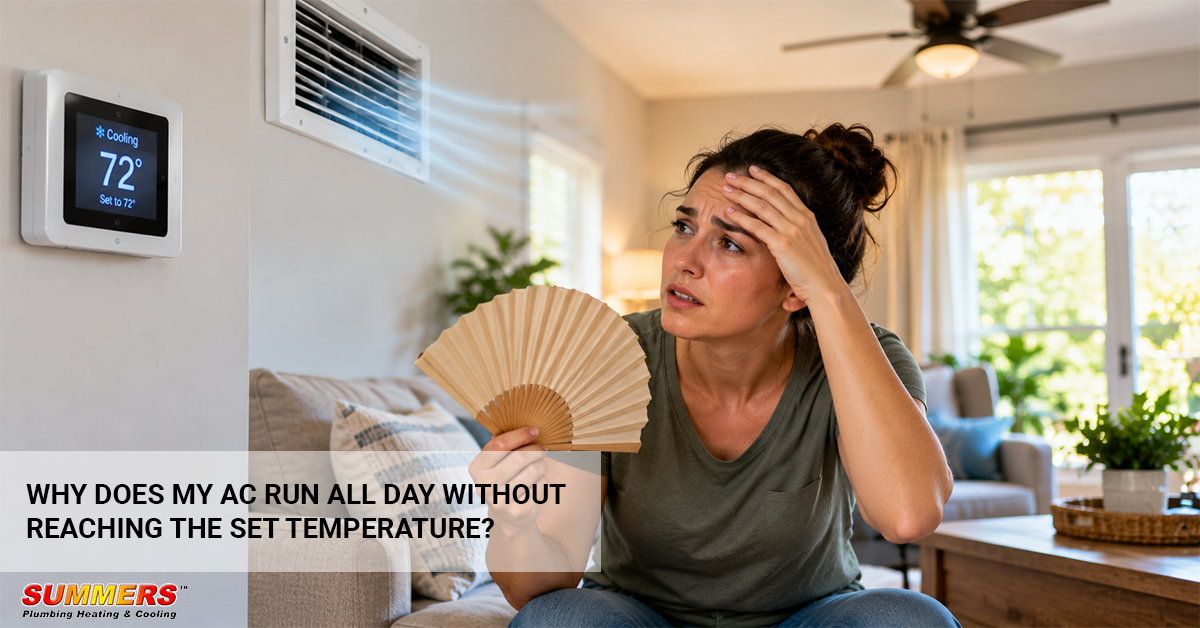
Your AC may run all day without reaching the set temperature because of a dirty air filter, low refrigerant, dirty coils, poor insulation, or an undersized air conditioning system. A faulty thermostat can also prevent your home from cooling properly.
In very hot weather, an AC may run for long periods to maintain your desired temperature. However, if your home stays several degrees warmer than the thermostat setting, or the temperature never drops even after hours of operation, something may be wrong.
Start by checking the air filter, thermostat settings, windows, doors, and supply vents. If these checks don’t help, the problem may involve the refrigerant, condenser, compressor, or another component that needs professional attention.
In this guide, you’ll learn why your AC keeps running, what you can safely check yourself, and when to call an HVAC technician.
Why Does My AC Run All Day Without Reaching the Set Temperature?
An AC that runs all day without reaching the set temperature may have restricted airflow, a refrigerant problem, excessive heat entering the home, or insufficient cooling capacity. The exact cause depends on your home’s conditions and how the system performs.
Your thermostat tells the AC when to cool your home. Once the room reaches the target temperature, the system usually cycles off or reduces its output if it’s a variable-speed model. If the temperature stays above the setting, the AC may continue running because it cannot remove heat fast enough.
For example, if your thermostat is set to 72°F but your home stays at 78°F for hours, your system may be struggling to meet the cooling demand.
When Is Continuous AC Operation Normal?
Continuous operation isn’t always a sign of a problem. Your AC may run for extended periods during very hot weather, especially when outdoor temperatures are high or your home has significant heat gain.
Longer run times can also be normal for variable-speed systems designed to operate at lower speeds for longer periods.
However, investigate the problem if:
- Your home stays several degrees above the thermostat setting.
- The AC runs continuously but indoor temperatures keep rising.
- Air from the vents feels warmer than usual.
- You notice ice on the indoor coil or refrigerant lines.
- Your electricity bills increase alongside poor cooling performance.
How Can You Tell If Your AC Isn’t Cooling Properly?
Check the thermostat’s temperature reading and compare it with a separate thermometer placed nearby. Make sure the thermostat is set to Cool and the target temperature is below the current room temperature.
Next, check the air filter and make sure supply vents and return grilles are clear. If the system still cannot lower the temperature, an HVAC technician can inspect airflow, refrigerant levels, coils, and other components.
Important: There is no single temperature difference that proves every AC system is working correctly. Cooling performance depends on indoor and outdoor conditions, system design, humidity, and other factors.
8 Common Reasons Your AC Runs All Day Without Reaching the Set Temperature
An AC that runs continuously without reaching the thermostat setting usually has a problem with airflow, cooling capacity, heat gain, or a system component. Identifying the cause can help you determine whether a simple adjustment or professional repair is needed.
Here are eight common reasons your AC may struggle to cool your home.
1. A Dirty or Clogged Air Filter
A dirty air filter can restrict airflow and make your AC work harder to cool your home. When dust, pet hair, and debris build up on the filter, less air passes through the evaporator coil, reducing the system’s ability to transfer heat.
Common signs include:
- Weak airflow from the vents
- Rooms taking longer to cool
- A dirty or clogged filter
- Ice forming on the indoor coil in some cases
What should you do?
Turn off the AC and inspect the filter. Replace it if it’s dirty, using the correct size and type recommended by the manufacturer. Check the filter regularly during heavy use.
If your AC still runs continuously after you replace the filter, another problem may be affecting its performance.
To prevent airflow restrictions from a neglected filter, learn how often to change your AC filter based on your filter type, system, and household conditions.
2. Low Refrigerant or a Refrigerant Leak
Low refrigerant can prevent your AC from removing enough heat from indoor air. Refrigerant circulates through the system to absorb heat indoors and release it outside. If the system has a leak, its cooling capacity may decrease.
Possible signs include:
- The AC runs for long periods without cooling the home
- Warm or insufficiently cool air comes from the vents
- Ice forms on refrigerant lines or the evaporator coil
- A hissing or bubbling sound near the equipment
What should you do?
Contact a qualified HVAC technician to check refrigerant levels, test for leaks, and repair the underlying problem. Simply adding refrigerant without addressing a leak may not solve the issue.
Don’t attempt to handle refrigerant yourself.
3. A Dirty Evaporator or Condenser Coil
Dirty AC coils can reduce heat transfer and make your system less effective at cooling your home. The indoor evaporator coil absorbs heat from indoor air, while the outdoor condenser coil releases that heat outside.
Dust on the evaporator coil can also restrict airflow. Dirt and debris around the outdoor condenser can interfere with heat release.
Common signs include:
- The AC runs longer than usual
- Indoor temperatures remain above the thermostat setting
- Cooling performance gradually declines
- The outdoor unit has visible dirt or debris around it
What should you do?
Replace a dirty air filter and keep leaves, grass, and other debris away from the outdoor unit. Turn off power before performing any basic exterior cleaning permitted by the manufacturer.
If the coils are heavily soiled or difficult to access, schedule professional cleaning. Avoid bending delicate coil fins or spraying electrical components.
4. An AC Unit That’s Too Small for Your Home
An undersized AC may struggle to maintain the desired temperature when outdoor temperatures rise. If the unit cannot remove heat as quickly as it enters the home, it may run for hours without reaching the thermostat setting.
This can happen when the system was incorrectly sized, the home has been expanded, or cooling requirements have changed.
Possible signs include:
- The home struggles to cool during hot afternoons
- The AC runs for long periods on the hottest days
- Some rooms remain uncomfortable despite normal airflow
- The problem persists even after routine maintenance
What should you do?
Have an HVAC professional assess your home’s cooling requirements and the existing system. A proper load calculation considers factors such as square footage, insulation, windows, climate, and air leakage.
Don’t assume the AC is undersized based on long run times alone. Dirty coils, refrigerant issues, and other repairable problems can cause similar symptoms.
5. Hot Air Leaking Into the House
Hot air entering your home through gaps around windows, doors, attic openings, or other poorly sealed areas increases the AC’s cooling workload. The system must remove both the heat already inside and the additional heat entering from outside.
Common signs include:
- Certain rooms feel warmer than others
- You notice drafts around doors or windows
- Indoor temperatures rise during the hottest part of the day
- The AC runs longer when outdoor temperatures increase
What should you do?
Close exterior doors and windows while the AC is running. Check weatherstripping around doors and look for obvious gaps around windows.
Sealing air leaks can reduce unwanted heat entering your home. For persistent problems, an energy assessment can help identify hidden air leaks and insulation issues.
6. Poor Attic Insulation or Excessive Heat Gain
Poor insulation can allow heat from a hot attic or roof to enter your living space. Direct sunlight through windows and heat entering through walls can also increase your home’s cooling demand.
When heat enters faster than the AC can remove it, the thermostat may never reach its target temperature during the hottest hours.
Common signs include:
- Upstairs rooms stay hotter than downstairs rooms
- The home heats up quickly during sunny afternoons
- The AC runs much longer on hot days
- Certain rooms remain uncomfortable despite adequate airflow
What should you do?
Use suitable blinds or curtains to reduce direct sunlight through windows. Check for obvious insulation gaps where it is safe to do so.
If the problem continues, consider a professional home energy assessment. Improving insulation and sealing air leaks may help reduce heat gain and cooling demand.
7. A Faulty Thermostat or Incorrect Thermostat Placement
A faulty thermostat can give inaccurate temperature readings or fail to control the AC correctly. Poor placement can also cause misleading readings.
For example, a thermostat near a sunny window, heat-producing appliance, or warm air source may sense more heat than the rest of the room. This can cause the system to continue running longer than necessary.
Common signs include:
- The displayed temperature doesn’t match the room’s actual temperature
- The AC keeps running after the room feels cool
- The system switches on and off unexpectedly
- The thermostat settings appear correct, but cooling behavior is unusual
What should you do?
Confirm that the thermostat is set to Cool and that its target temperature is below the current room temperature. Check the manufacturer’s instructions for batteries if your model uses them.
Keep heat-producing devices away from the thermostat and avoid placing portable fans directly against it. If readings remain inaccurate or the AC won’t respond correctly, arrange a professional inspection.
For more guidance on adjusting your system, review these smart thermostat cooling settings to make sure your cooling schedule and temperature targets are appropriate.
8. A Failing Compressor or Another Mechanical Problem
A failing compressor or another damaged component can reduce an AC’s cooling capacity. The compressor helps circulate refrigerant through the system, so a serious compressor problem may prevent the unit from removing enough heat.
Electrical faults, failing capacitors, and other mechanical issues can also interfere with system operation.
Warning signs may include:
- The AC runs but provides little cooling
- The outdoor unit makes unusual noises
- The system trips a circuit breaker
- Cooling performance suddenly declines
- The outdoor unit’s fan or compressor appears not to operate normally
What should you do?
Turn the system off if you notice burning smells, repeated breaker trips, or unusual electrical noises. Contact a qualified HVAC technician to diagnose the problem.
Avoid opening electrical compartments or attempting compressor repairs yourself. A technician can determine whether the issue requires a component repair or a more extensive solution.
If your AC needs professional attention, read our guide to AC repair costs in Bloomington, Indiana to understand the factors that can affect the price of a repair.
How to Fix an AC That Runs All Day Without Reaching the Set Temperature
You can troubleshoot an AC that runs all day by checking the air filter, thermostat settings, vents, windows, and outdoor unit. These basic steps may resolve simple problems, but persistent cooling issues often require professional diagnosis.
Follow these steps in order.
1. Check and Replace the Air Filter
Turn off the AC and inspect the air filter. If it’s clogged with dust or pet hair, replace it with the correct filter recommended by the manufacturer.
A clean filter helps maintain proper airflow across the evaporator coil. If the filter is clean and the AC still struggles to cool, check the other possible causes.
2. Confirm the Thermostat Settings
Make sure the thermostat is set to Cool and the target temperature is below the current indoor temperature. Check that the thermostat isn’t following an unexpected schedule or energy-saving setting.
If the displayed temperature seems inaccurate, compare it with a separate thermometer placed nearby.
3. Close Windows and Exterior Doors
Open windows and exterior doors allow warm air to enter and cooled air to escape. Keep them closed while the AC is running.
Check weatherstripping around doors and windows for obvious gaps. Sealing these gaps can help reduce heat entering your home.
4. Check Supply Vents and Return Grilles
Make sure supply vents are open and aren’t blocked by furniture, curtains, or rugs. Keep return air grilles clear so the system can draw air back into the unit.
If some rooms remain warm while others cool normally, the problem may involve ductwork, dampers, or airflow balancing.
5. Keep the Outdoor Condenser Clear
Remove loose leaves, grass, and other debris from around the outdoor unit, following the manufacturer’s clearance recommendations.
Restricted airflow around the condenser can reduce the system’s ability to release heat. Don’t open the unit or spray water onto electrical components.
6. Look for Signs of Ice or Water Leaks
Check for visible ice on refrigerant lines or around the indoor unit. A frozen evaporator coil can restrict airflow and reduce cooling.
If you notice ice, turn off cooling mode and let it melt naturally. Check the filter, but don’t chip away at the ice or dismantle the unit.
If freezing returns, contact an HVAC technician. Water leaking around the indoor unit also deserves attention, as it may indicate a drainage problem or melting ice.
7. Schedule Professional AC Maintenance
If the AC still cannot reach the set temperature, arrange a professional inspection.
If your AC continues running without cooling your home properly, professional AC repair in Bloomington, IN can help identify the underlying problem and restore cooling performance. A technician can check refrigerant levels, inspect coils, test electrical components, measure airflow, and evaluate the compressor.
Important: Don’t keep lowering the thermostat to force the AC to cool faster. Most systems don’t cool faster just because you choose a much lower setting. Fixing the underlying problem is the better solution.
Is It Normal for an AC to Run All Day in Hot Weather?
Yes, an AC can run all day during extremely hot weather, especially when temperatures are high or your home gains heat quickly. However, if the system runs continuously but never reaches the set temperature, it may have a cooling problem.
Modern central air conditioners are designed to run longer during periods of high cooling demand. Variable-speed systems may operate at lower speeds for extended periods to maintain a more consistent indoor temperature.
When Is Continuous AC Operation Normal?
Long AC run times may be normal when:
- Outdoor temperatures are extremely high.
- Your home has large windows that receive direct sunlight.
- You have a variable-speed or high-efficiency AC system.
- The AC is removing excess indoor humidity.
- Your home has significant heat gain during the afternoon.
In these situations, the system may need more time to maintain your preferred temperature.
When Does Continuous AC Operation Indicate a Problem?
Your AC may need attention if:
- Indoor temperatures keep rising despite continuous operation.
- The thermostat setting remains several degrees below the actual room temperature.
- Air from the vents feels warmer than usual.
- Airflow is noticeably weaker than normal.
- Ice forms on the indoor coil or refrigerant lines.
- Your electricity bills increase while cooling performance declines.
These signs can point to restricted airflow, low refrigerant, dirty coils, poor insulation, or a mechanical fault.
How Can You Tell the Difference?
Monitor the indoor temperature during the hottest part of the day and again when outdoor temperatures fall. If your AC maintains a comfortable temperature but runs for long periods, the operation may be normal.
If the indoor temperature continues to climb or stays well above the thermostat setting, check the air filter and vents. If the problem persists, have an HVAC technician inspect the system.
Tip: Don’t judge your AC’s performance by run time alone. Its ability to maintain the indoor temperature and provide consistent cooling is more useful when deciding whether something is wrong.
Why Does My AC Stay 5–10 Degrees Above the Set Temperature?
If your AC stays 5–10 degrees above the thermostat setting, it may not be removing heat from your home fast enough. Common causes include a dirty air filter, low refrigerant, dirty coils, excessive heat entering the house, or an AC system that cannot meet the cooling demand.
For example, if your thermostat is set to 72°F but the indoor temperature stays around 78°F, your system may be struggling to maintain the target temperature.
Common Reasons Your AC Can’t Reach the Set Temperature
- Restricted airflow: A clogged filter or blocked return grille can reduce the amount of air moving through the system.
- Low refrigerant: A refrigerant leak can reduce the AC’s ability to absorb heat.
- Dirty coils: Dirt on the evaporator or condenser coil can interfere with heat transfer.
- Excessive heat gain: Poor insulation, open windows, or direct sunlight can increase indoor temperatures.
- Incorrect system sizing: An undersized AC may struggle to keep up during very hot weather.
- Thermostat problems: An inaccurate reading or incorrect placement can affect temperature control.
What Should You Check?
Start by comparing the thermostat reading with a separate thermometer placed nearby. Confirm that the thermostat is set to Cool and that the air filter is clean.
Next, make sure windows and exterior doors are closed and supply vents are unobstructed. Check the outdoor unit for visible debris around its exterior, following the manufacturer’s safety guidance.
If the temperature remains 5–10 degrees above the setting after these checks, schedule an HVAC inspection. A technician can test airflow, inspect the coils, check refrigerant levels, and assess the system’s cooling capacity.
Important: A 5–10-degree difference doesn’t automatically mean your AC is broken. Indoor and outdoor temperatures, humidity, insulation, and system design all affect cooling performance. Persistent temperature differences are more concerning when the AC runs continuously and the home remains uncomfortable.
Why Does My AC Run Constantly but the House Still Feels Hot?
If your AC runs constantly but your house still feels hot, the system may not be removing enough heat or humidity from the indoor air. Restricted airflow, dirty coils, low refrigerant, poor insulation, or a faulty component can all contribute to this problem.
Even when the AC runs continuously, your home may feel uncomfortable if warm air keeps entering or the system cannot cool the space effectively.
Common Reasons Your House Still Feels Hot
- Warm air from the vents: The AC may have a refrigerant problem, compressor issue, or another cooling fault.
- Weak airflow: A dirty filter, blocked return grille, or blower problem may prevent enough air from reaching your rooms.
- High indoor humidity: Humid air can make a room feel warmer and stickier, even when the temperature seems reasonable.
- Heat entering through windows and walls: Direct sunlight, poor insulation, and air leaks increase the cooling load.
- Uneven cooling: Duct leaks, closed dampers, or airflow balancing problems can leave certain rooms uncomfortable.
- Dirty AC coils: Dirty indoor or outdoor coils can reduce heat transfer and cooling performance.
How to Make Your Home Feel Cooler
Start by checking the filter, clearing vents, and keeping windows and exterior doors closed. Use blinds or curtains to reduce direct sunlight through windows.
If indoor humidity remains high, the AC may not be removing moisture effectively. Avoid assuming that lowering the thermostat will solve the problem if the system already runs continuously.
If the house remains hot despite these checks, contact an HVAC technician to inspect airflow, refrigerant, coils, and system performance.
Tip: Pay attention to both temperature and humidity. If your home feels sticky or clammy despite reasonable cooling, moisture removal may be part of the problem.
Can Running the AC All Day Increase Electricity Bills?
Yes, running your AC all day can increase electricity bills because the system uses electricity for extended periods. However, the actual cost depends on the AC’s efficiency, cooling capacity, thermostat setting, outdoor temperature, and how much heat enters your home.
An efficient AC that runs for longer periods may use less energy than an older, less efficient system that cycles frequently. The key issue is whether your AC is operating efficiently and keeping your home comfortable.
Why Does an AC That Runs All Day Use More Electricity?
Several factors can increase energy consumption:
- Dirty air filter: Restricted airflow can reduce system performance and contribute to longer cooling cycles.
- Low refrigerant: A refrigerant leak can reduce cooling capacity and cause the AC to run longer.
- Dirty coils: Poor heat transfer makes it harder for the system to remove heat.
- Poor insulation: Heat entering through the attic, walls, and windows increases cooling demand.
- Low thermostat settings: Setting the temperature lower than necessary can increase cooling time.
- Aging or inefficient equipment: Older systems may use more electricity to provide the same amount of cooling.
How Can You Reduce AC Running Costs?
Try these steps to improve efficiency:
- Replace dirty air filters with the correct type and size.
- Set the thermostat to a comfortable temperature rather than unnecessarily low.
- Close windows and exterior doors while the AC is running.
- Use blinds or curtains to reduce direct sunlight.
- Keep supply vents and return grilles clear.
- Arrange regular maintenance to keep the system clean and operating properly.
If your AC runs continuously but your home remains warm, have it inspected instead of simply accepting higher electricity bills. Repairing an underlying problem may improve cooling performance and reduce wasted energy.
You can also explore these practical ways to reduce utility bills while improving your home’s energy efficiency.
Bottom line: Continuous operation doesn’t automatically mean your AC is inefficient. But if long run times come with poor cooling and rising bills, the system may need maintenance or repair.
When Should You Call an HVAC Technician?
You should call an HVAC technician if your AC runs all day without reaching the set temperature, even after checking the air filter, thermostat, and vents. Persistent cooling problems may indicate a refrigerant leak, dirty coils, a faulty compressor, or another issue that requires professional repair.
Signs Your AC Needs Professional Repair
Contact an HVAC technician if you notice any of these problems:
- The temperature keeps rising: Your AC runs continuously, but your home remains warmer than the thermostat setting.
- Warm air comes from the vents: The system operates, but the air isn’t cooling properly.
- Ice forms on the AC unit: A frozen evaporator coil may indicate restricted airflow or a refrigerant problem.
- Unusual noises occur: Humming, grinding, or repeated clicking may indicate a mechanical or electrical fault.
- Water leaks around the indoor unit: The cause may involve a clogged drain or a frozen coil that has melted.
- Your electricity bills increase: Higher bills combined with poor cooling may indicate reduced system performance.
What Will an HVAC Technician Check?
A qualified technician can inspect the air filter, evaporator and condenser coils, blower motor, refrigerant system, thermostat, and electrical components.
They may also measure airflow, check for refrigerant leaks, and evaluate whether the AC has enough cooling capacity for your home.
Once the cause is identified, the technician can recommend the appropriate repair rather than replacing parts unnecessarily.
Should You Keep Running an AC That Won’t Reach the Set Temperature?
If the AC is running but cooling poorly, avoid letting it operate continuously for days without investigating the problem. Check simple issues first, and arrange service if performance doesn’t improve.
If you notice burning smells, repeated circuit breaker trips, or signs of an electrical fault, turn the system off and contact a qualified professional. If the unit is freezing up, turn off cooling mode and allow the ice to melt naturally while arranging an inspection.
Bottom line: Long run times can be normal in hot weather, but an AC that consistently fails to cool your home needs attention. Early diagnosis can help restore comfort and prevent avoidable energy waste.
Frequently Asked Questions
1. Why won’t my AC reach the temperature set on the thermostat?
Your AC may not reach the set temperature because of a dirty air filter, low refrigerant, dirty coils, poor insulation, or insufficient cooling capacity. Check the filter and thermostat settings first. If the problem continues, arrange an HVAC inspection.
2. How long should an AC take to cool a house?
The time depends on the home’s size, insulation, outdoor temperature, humidity, and AC capacity. A home may take several hours to cool significantly in very hot weather. If the temperature barely changes despite continuous operation, your system may need inspection.
3. Should I turn off my AC if it runs all day?
Not necessarily. Continuous operation can be normal during extreme heat or with certain variable-speed systems. However, if your home stays uncomfortably warm, check the filter and vents. If the AC still cannot cool properly, have it inspected.
4. Can low refrigerant make an AC run constantly?
Yes. Low refrigerant caused by a leak can reduce cooling capacity, making the AC run longer without reaching the thermostat setting. An HVAC technician should locate and repair the leak before recharging the system.
5. Does a dirty air filter prevent an AC from reaching the set temperature?
Yes. A clogged air filter restricts airflow and reduces cooling performance. Replace it with the correct filter recommended by the manufacturer. If the AC still struggles to cool, another problem may be responsible.
6. How do I know if my AC is undersized?
An undersized AC may struggle to maintain the desired temperature during hot weather, even when properly maintained. However, long run times alone don’t prove the unit is too small. An HVAC professional can perform a cooling load calculation to determine the appropriate capacity.
7. Can a faulty thermostat cause continuous AC operation?
Yes. A faulty thermostat, inaccurate temperature reading, or poor placement can cause the AC to run longer than necessary. Check the settings and compare the displayed temperature with a separate thermometer. If readings differ significantly, arrange a thermostat inspection.
8. Is it cheaper to leave the AC running all day or turn it off?
It depends on the weather, home insulation, AC efficiency, and how long you’re away. Turning the thermostat up while you’re away can reduce cooling demand, but completely turning off the AC may allow indoor temperatures and humidity to rise significantly. Choose a reasonable setting based on your comfort and climate.
9. Why does my AC reach the set temperature at night but not during the day?
During the day, higher outdoor temperatures and direct sunlight increase the amount of heat entering your home. Your AC may struggle to keep up during peak heat but perform better at night. If the difference is severe or new, check the filter and have the system inspected if needed.
Final Thoughts
If your AC runs all day without reaching the set temperature, the cause may be a dirty air filter, low refrigerant, dirty coils, poor insulation, or an undersized system. Extremely hot weather can also increase cooling time, but persistent poor performance shouldn’t be ignored.
Start by checking the air filter, thermostat settings, supply vents, and windows. If your home still won’t reach the desired temperature, contact a qualified HVAC technician to identify the problem and recommend the right repair.
Addressing the cause early can help restore indoor comfort, improve cooling performance, and avoid unnecessary energy costs.