
How Hard Is Kokomo’s Water? What 21–23 Grains per Gallon Does to Your Water Heater and Fixtures
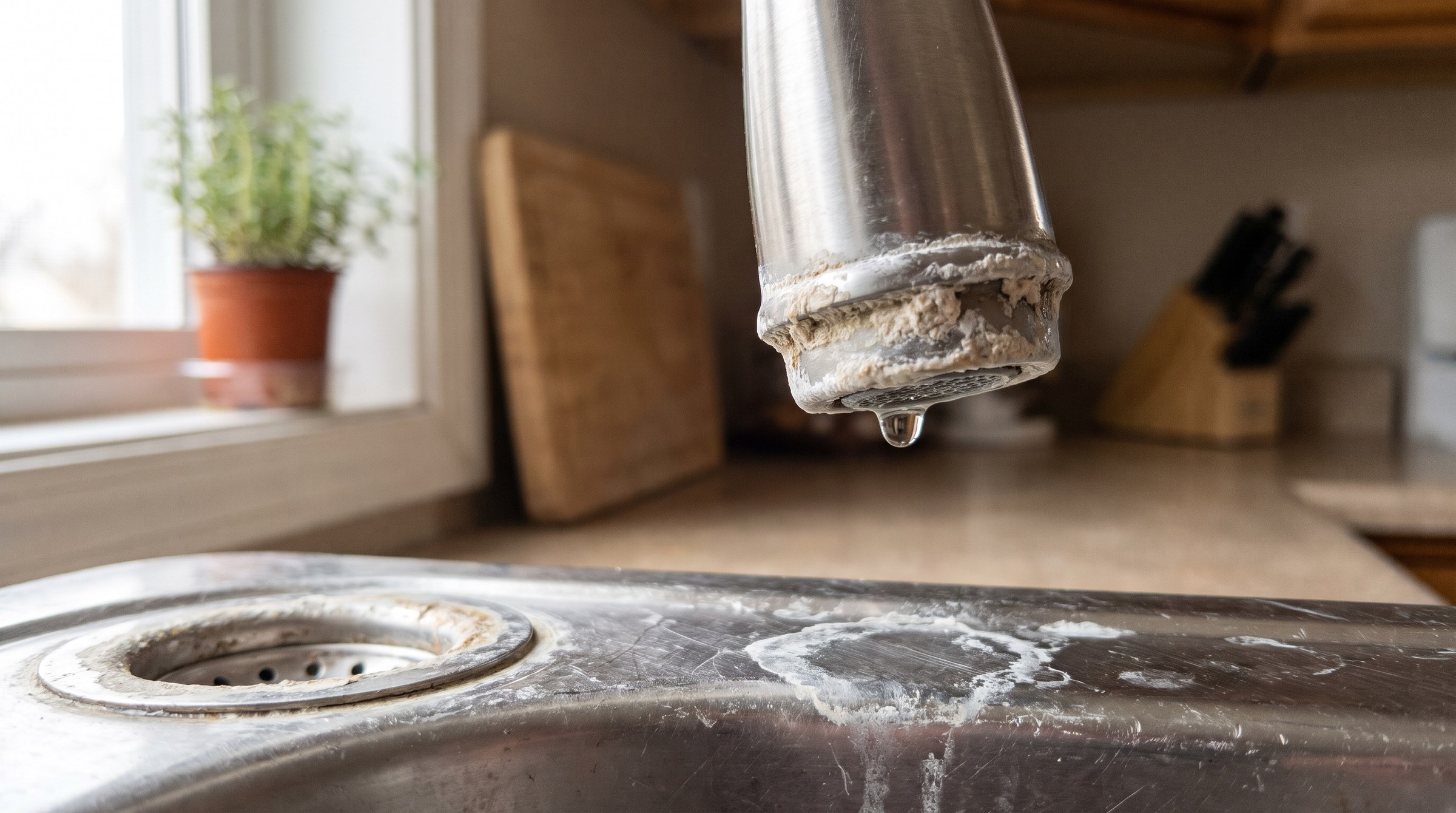
If you’ve lived in Kokomo for a while, you already know the signs: white crust on the faucet, spots on every glass that comes out of the dishwasher, a showerhead that sprays sideways after a year. That is hard water, and Kokomo’s is harder than most. Here is what the numbers actually say, what it means for your plumbing and water heater, and how to decide what to do about it.
What Kokomo’s water report says
Most of Kokomo gets its water from Indiana American Water. The utility’s 2025 annual water quality report for Kokomo lists hardness measured at its two treatment plants:
- Superior Street plant: average 363 parts per million (ppm), with a range of 240 to 520 ppm
- Philips Street plant: average 386 ppm, with a range of 320 to 480 ppm
The report lists the source of the hardness as “naturally occurring.” It comes from calcium and magnesium the water picks up underground and in the creek. Indiana American Water’s older typical water quality sheet for the area south of North Street, which draws from groundwater wells and Wildcat Creek, listed 320 mg/L, or 18.7 grains per gallon.
For context, the U.S. Geological Survey classifies water above 180 mg/L as “very hard.” Kokomo’s plant averages are about double that line.
Converting ppm to grains per gallon
Water softeners and test kits usually talk in grains per gallon (gpg), not ppm. The conversion is easy: divide ppm by 17.1.
- 363 ppm is about 21 gpg
- 386 ppm is about 23 gpg
- The full reported range, 240 to 520 ppm, works out to roughly 14 to 30 gpg
That range is the reason you can’t just pick a number off the report. Your tap depends on which plant serves your part of town and what time of year it is. When sizing equipment, a home test of your own water beats any average.
If you are in a rural part of Howard County on a private well, the city report doesn’t apply to you at all. Well water around here is often hard too, and it can carry iron as well, so testing matters even more.
What hard water does inside your house
Your water heater takes the biggest hit
When hard water is heated, the minerals come out of solution and settle to the bottom of the tank as scale. That layer sits between the burner or element and the water, so the heater works harder to do the same job. It is also what makes the popping and rumbling noises many Kokomo homeowners hear. We covered those sounds in Water Heater Making Noise?, and how often to drain the tank in How Often Should You Flush Your Water Heater?
Tankless water heaters are not immune either. Scale builds up in the heat exchanger, which is why manufacturers call for periodic descaling in hard water areas. If you are thinking about going tankless in Kokomo, plan for water treatment or regular flushing.
Fixtures and appliances
- Aerators and showerheads clog with scale, so flow drops.
- Faucet cartridges and toilet fill valves wear out sooner.
- Dishwashers and washing machines leave film and spots, and you end up using more detergent.
- Glass shower doors and tile grout get a cloudy crust that is hard to clean.
You, too
Hard water doesn’t make soap lather well, so many people notice dry skin and dull hair. Hard water is not a health problem, but it is a daily annoyance.
Your options
A water softener
A softener swaps calcium and magnesium for sodium (or potassium) ions as water passes through a resin tank. It is the standard fix for hardness at Kokomo’s levels. The key is sizing it for your actual hardness and your household’s water use. A unit sized for “average Indiana water” can regenerate constantly, or let hard water slip through, when it meets 20+ gpg. Our water softener page explains how we size and install systems.
One note on sodium: the 2025 report already lists sodium in the treated water at 29.6 ppm from the Superior Street plant and 17.1 ppm from Philips Street. Softening adds a bit more. If someone in the house is on a low-sodium diet, ask about potassium chloride or a drinking-water filter at the kitchen sink.
Reverse osmosis for drinking water
A reverse osmosis system at the kitchen tap removes most dissolved minerals, including sodium, for drinking and cooking. It pairs well with a softener for the rest of the house.
Filtration for other issues
If you also have taste, odor or iron problems (common on wells), a whole-home filtration system may be needed ahead of the softener.
Maintenance if you do nothing else
If a softener isn’t in the budget yet, you can still slow the damage:
- Flush your water heater on a regular schedule.
- Soak aerators and showerheads in white vinegar every few months.
- Lower the water heater temperature a little if it is set high, since scale forms faster at higher temperatures.
- Watch for slow fill valves and dripping faucets, which often trace back to scale.
How to test your own water
Hardness test strips from a hardware store will give you a ballpark in a couple of minutes. For sizing a softener, a more precise test is better, and if you’re on a well, a lab test that checks iron and bacteria too is worth it. Test at a cold tap that isn’t already softened.
Frequently Asked Questions
How hard is Kokomo’s water?
Indiana American Water’s 2025 report for Kokomo lists average hardness of 363 ppm at the Superior Street plant, with a range of 240 to 520, and 386 ppm at the Philips Street plant, with a range of 320 to 480. The U.S. Geological Survey classifies anything above 180 mg/L as very hard, so Kokomo’s averages are about double that line.
How do I convert ppm to grains per gallon?
Divide parts per million by 17.1. Kokomo’s plant averages of 363 and 386 ppm work out to roughly 21 and 23 grains per gallon, and the full reported range of 240 to 520 ppm is roughly 14 to 30 grains per gallon. Because your tap can fall anywhere in that range, test your own water before sizing a softener.
Is Kokomo’s hard water safe to drink?
Yes. The water report lists hardness as naturally occurring, and the U.S. Geological Survey describes hardness as a nuisance rather than a health concern. The problems it causes are practical ones: scale in water heaters, clogged aerators and showerheads, spotty dishes and soap that doesn’t lather well.
What size water softener does a Kokomo home need?
It depends on your measured hardness and how much water your household uses. A softener sized for average Indiana water can regenerate constantly or let hard water slip through when it meets 20-plus grains per gallon. Test a cold tap that isn’t already softened, then size the unit to that number and your daily usage.
Will a water softener add sodium to my water?
Softening adds a small amount of sodium. Kokomo’s 2025 report already lists sodium at 29.6 ppm from the Superior Street plant and 17.1 ppm from the Philips Street plant. If someone in your home is on a low-sodium diet, ask about potassium chloride instead of salt, or a reverse osmosis system at the kitchen tap for drinking and cooking water.
I’m on a well outside Kokomo. Do these numbers apply to me?
No. The Indiana American Water report only covers homes on that system. Private wells in Howard County can be hard too and may also carry iron, so a lab test that checks hardness, iron and bacteria is the right starting point before choosing a softener or filtration system.
Get a straight answer on your water
In Kokomo or out in Greentown or Russiaville, Summers of Kokomo can test your water, check your water heater for scale and recommend the right setup for your house. We have been serving Kokomo since 1969. Call (765) 236-1212 to schedule.