Best HVAC Filters for Wildfire Smoke and Allergies
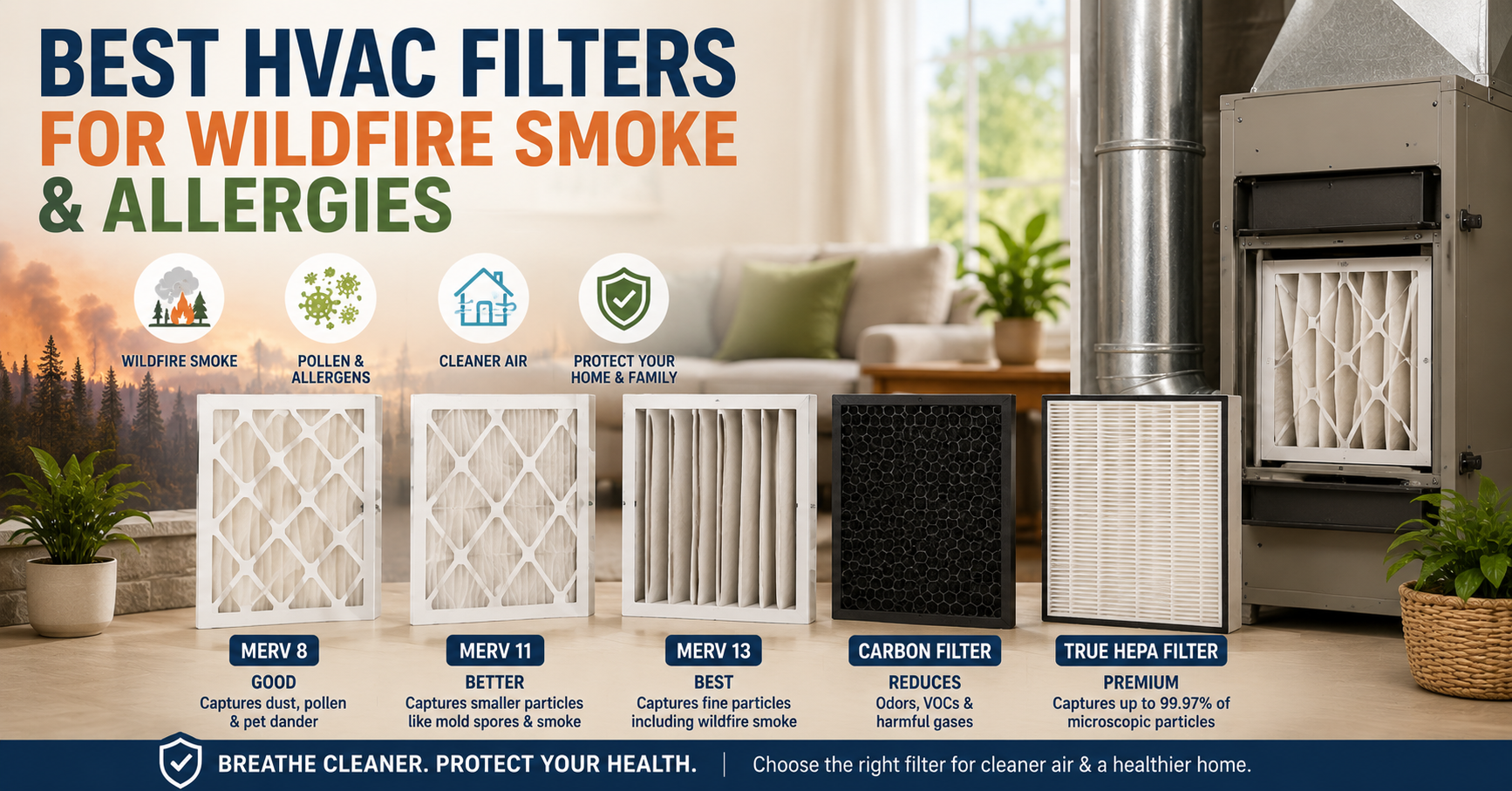
MERV 13 is a strong choice for wildfire smoke and allergies if your HVAC system is designed to handle it. It can capture more small airborne particles than lower-rated filters, including particles from smoke, pollen, dust, and pet dander.
However, don’t assume MERV 13 is right for every HVAC system. A filter that’s too restrictive can reduce airflow and put extra strain on the system.
When choosing a filter, look at more than the MERV number. The filter size, pressure drop, airflow, and your HVAC manufacturer’s recommendations all matter.
If your system can’t safely handle MERV 13, choose the highest MERV rating the manufacturer recommends. A properly fitted MERV 11 filter is better than an incompatible MERV 13 filter that restricts airflow.
What Is the Best HVAC Filter for Wildfire Smoke and Allergies?
MERV 13 is a strong HVAC filter choice for wildfire smoke and allergies when your system can safely handle it. It offers better filtration of small airborne particles than lower-MERV filters.
Wildfire smoke contains fine particles that can travel deep into the indoor air. Allergens such as pollen, dust, and pet dander can also become airborne and circulate through your HVAC system.
A MERV 13 filter can capture a greater share of these particles as air passes through the filter. For many homes, it offers a good balance between particle filtration and practical HVAC performance.
However, MERV 13 isn’t the right choice for every system. Check your HVAC manufacturer’s recommendations before upgrading the filter. If your system isn’t designed for MERV 13, use the highest MERV rating the manufacturer approves.
A properly supported MERV 11 filter is a better choice than a MERV 13 filter that creates excessive airflow resistance.
Why Is MERV 13 a Good Choice for Smoke and Allergies?
MERV 13 is a good choice for smoke and allergies because it can capture a higher percentage of smaller airborne particles than lower-MERV filters.
It can help filter particles such as:
- Fine particles from wildfire smoke
- Pollen
- Dust
- Pet dander
- Mold spores
- Other airborne particles
This makes MERV 13 useful when you’re trying to reduce fine particles circulating through your HVAC system.
However, an HVAC filter only captures particles that actually pass through it. It won’t remove dust, dander, or other particles that have already settled on floors, furniture, carpets, or bedding. Regular cleaning is still important.
It’s also important to understand that MERV measures particle filtration, not odor removal. If wildfire smoke has left a strong smell indoors, a MERV 13 filter alone may not be enough. A filter or air-cleaning system with activated carbon can help address certain gases and odors in addition to particle filtration.
MERV 8 vs. MERV 11 vs. MERV 13 for Smoke and Allergies
MERV 13 provides the highest filtration of these three ratings, but MERV 11 may be a better choice if your HVAC system cannot handle the added airflow resistance.
Here’s a simple comparison:
| Feature | MERV 8 | MERV 11 | MERV 13 |
| Basic dust | Good | Better | Better |
| Pollen | Good | Better | Better |
| Pet dander | Good | Better | Better |
| Fine smoke particles | Limited | Better | Stronger |
| Airflow resistance | Generally lower | Moderate | Can be higher |
| Best for | Basic filtration | Improved filtration | Higher particle filtration |
These are general comparisons. Actual filtration and airflow resistance vary between filters, even when they have the same MERV rating.
MERV 8 can be enough for basic dust and particle filtration. MERV 11 offers a step up in filtration. MERV 13 is the better choice when you want stronger filtration of fine particles, especially during wildfire smoke events.
If your HVAC system is rated for MERV 13, it’s generally the strongest option of the three for wildfire smoke and fine airborne particles. If it isn’t, use the highest MERV rating your manufacturer recommends rather than risking excessive airflow restriction.
Can an HVAC Filter Remove Wildfire Smoke?
An HVAC filter can capture many of the fine particles in wildfire smoke, but it cannot remove every pollutant found in smoke.
Wildfire smoke contains a mixture of very small particles and gases. A properly rated HVAC filter can capture particulate matter as smoky air passes through the filter.
That’s why the filter’s MERV rating matters during wildfire smoke events. Higher-efficiency filters can capture more fine particles than lower-rated filters, provided your HVAC system can safely handle them.
However, standard HVAC filters are designed mainly for particle filtration, not complete smoke removal. They won’t necessarily remove smoke-related gases or strong odors.
When wildfire smoke is affecting outdoor air quality, you can take several steps to reduce indoor exposure:
- Keep windows and exterior doors closed when smoke levels are high.
- Use HVAC recirculation when appropriate to avoid bringing smoky outdoor air inside.
- Use the highest-efficiency filter your HVAC system can safely handle.
- Check the filter more often because smoke particles can load it faster.
- Use a properly sized portable air cleaner in rooms where you spend the most time.
- Monitor local air-quality conditions and follow public-health recommendations.
For persistent smoke odors, consider filtration that includes activated carbon, since particle filters alone don’t remove all smoke-related gases and odors.
Can HVAC Filters Help With Allergies?
Yes, a properly rated HVAC filter can help reduce airborne allergens such as pollen, dust, and pet dander as air passes through your system.
The filter only works when airborne particles actually pass through it. It won’t remove allergens that have already settled on carpets, bedding, furniture, floors, or other surfaces.
A higher-efficiency filter can capture more small airborne particles, but your HVAC system must be able to handle the filter without excessive airflow restriction.
For better results, combine HVAC filtration with regular cleaning. Vacuum carpets and furniture, wash bedding, reduce indoor dust, and address allergen sources instead of relying on the HVAC filter alone.
If allergies are a major concern, a properly sized portable air purifier can also provide additional air purification in frequently used rooms.
How to Choose the Right HVAC Filter for Wildfire Smoke and Allergies
Choose the highest-efficiency filter your HVAC system can safely handle, then make sure the filter fits correctly and doesn’t create excessive airflow resistance.
A good filter isn’t just about the MERV number. The filter’s size, thickness, design, and pressure drop also affect how well it works with your HVAC system. If you’re comparing filtration options before upgrading, see HEPA vs. standard HVAC filters to understand how the two approaches differ.
Check the MERV Rating
MERV 13 is a strong starting point for wildfire smoke and allergies if your HVAC system is designed to support it.
If your system has a lower recommended MERV rating, follow the manufacturer’s guidance instead.
A higher MERV rating can provide better particle filtration, but more filtration isn’t helpful if the filter restricts airflow too much.
Check Your HVAC Manufacturer’s Recommendation
Your HVAC manufacturer’s filter recommendation should be the first thing you check before upgrading to a higher MERV rating.
Look at your owner’s manual or the manufacturer’s specifications. If the information isn’t clear, an HVAC professional can check whether your system can handle a higher-efficiency filter and recommend appropriate indoor air services for your home.
Your HVAC system needs adequate airflow to operate properly. A filter that creates excessive pressure drop can affect system performance.
Choose the Correct Filter Size
The filter needs to be the correct size and fit securely so air doesn’t bypass it.
A filter that’s too small can leave gaps around the edges. Air can then travel around the filter instead of through the filter media.
Check the dimensions printed on your existing filter before buying a replacement. Also make sure the new filter sits properly in the filter track.
Consider Filter Thickness
A deeper filter can offer more filter surface area and may have lower airflow resistance than a thin filter with the same MERV rating.
For example, a 4-inch pleated filter generally has more surface area than a 1-inch filter of the same length and width.
However, filter thickness alone doesn’t determine performance. Check the manufacturer’s filtration and pressure-drop specifications for the specific filter you’re considering.
Look at Pressure Drop
Pressure drop measures how much resistance a filter creates as air moves through it.
Two filters with the same MERV rating can have different pressure drops because of differences in filter media, pleat design, thickness, and surface area.
When pressure-drop information is available, compare it with your HVAC system’s requirements.
The goal is to get strong particle filtration without creating more airflow resistance than your HVAC system can handle.
Does MERV 13 Restrict HVAC Airflow?
MERV 13 can increase airflow resistance compared with lower-MERV filters, but the actual effect depends on the filter design and your HVAC system.
MERV rating alone doesn’t tell you exactly how restrictive a filter will be. Factors such as these also affect pressure drop:
- Filter thickness
- Filter media
- Pleat design
- Filter surface area
- Airflow rate
That’s why two MERV 13 filters can have different pressure-drop ratings.
A deeper, well-designed pleated filter may provide more filtration surface area and lower resistance than a thin filter with the same MERV rating.
However, an HVAC system that isn’t designed to handle a restrictive filter may experience reduced airflow. That can affect heating and cooling performance and may put additional strain on the system.
When choosing a MERV 13 filter, consider both filtration efficiency and pressure drop. Check the filter manufacturer’s specifications and your HVAC manufacturer’s recommendations.
If you notice weaker airflow, longer heating or cooling cycles, unusual noises, or other changes after installing a higher-MERV filter, check the filter and have the HVAC system evaluated if the problem continues.
How Often Should You Change an HVAC Filter During Wildfire Smoke?
You may need to replace your HVAC filter sooner during heavy wildfire smoke because smoke particles can load the filter faster than normal.
Don’t rely only on your usual replacement schedule during a prolonged smoke event. Check the filter regularly, especially if your HVAC system runs frequently.
Replace the filter when it becomes visibly dirty or heavily loaded, or according to the manufacturer’s recommendations.
How quickly the filter loads can also depend on:
- Pets: Hair and dander add more particles to the filter.
- Indoor dust: Higher dust levels can shorten filter life.
- HVAC usage: More runtime means more air passes through the filter.
- Home renovations: Construction dust can quickly load a filter.
- Number of occupants: More activity can contribute to indoor particles.
- Outdoor smoke levels: Heavy smoke can increase the amount of particulate matter entering the home.
Don’t wait for a scheduled replacement date if the filter is already heavily loaded. A dirty filter can create greater airflow resistance, which can affect HVAC performance.
During extended wildfire smoke events, checking the filter every few days can be a practical precaution, especially when smoke levels are high and the HVAC system is running frequently.
Should You Use a HEPA Filter in Your HVAC System?
Don’t install a HEPA filter in a standard residential HVAC system unless you’ve confirmed that the system can handle its higher airflow resistance.
HEPA filters provide very high particle filtration, but that doesn’t mean they’re suitable for every central HVAC system. Their dense filter media can create significantly more pressure drop than many standard HVAC filters.
Some HVAC systems are specifically designed to work with HEPA filtration or have been modified to accommodate it. Others may not have enough blower capacity to maintain proper airflow with a HEPA filter.
If your system isn’t designed for HEPA filtration, a MERV 13 HVAC filter may be a more practical option for wildfire smoke and allergies. For more information about HEPA filters, see our guide to HEPA filtration. A properly sized portable HEPA air purifier is another option when you want additional particle filtration in a specific room.
Before installing a HEPA filter, check your HVAC manufacturer’s specifications or have an HVAC professional evaluate the system.
The goal is to improve filtration without restricting the airflow your HVAC system needs to operate properly.
Do HVAC Filters Remove Wildfire Smoke Odors?
Standard HVAC filters can capture many smoke particles, but they are not designed to remove wildfire smoke odors effectively.
Wildfire smoke contains both particles and gases. A MERV-rated filter is primarily designed to capture airborne particles, so a higher MERV rating doesn’t automatically mean better odor removal.
Some HVAC filters include activated carbon, which can adsorb certain gases and odors. However, how well carbon works depends on the amount, quality, and design of the carbon used.
If smoke odor is your main concern, don’t choose a filter based on MERV rating alone. Look for a filtration system that addresses both particle pollution and odors.
For stronger smoke protection, you may also consider a properly sized portable air cleaner with particle filtration and an appropriate amount of activated carbon.
In short, MERV 13 can help with smoke particles, while activated carbon is the component to look for when odor and gas removal are also important.
How to Use Your HVAC System During a Wildfire Smoke Event
During heavy wildfire smoke, keep smoky outdoor air out of your home as much as possible and use your HVAC system to recirculate and filter indoor air when appropriate.
Follow these steps during a smoke event:
- Keep windows and exterior doors closed. This helps limit the amount of outdoor smoke entering your home.
- Use the HVAC recirculation setting. If your system allows it, recirculate indoor air instead of continuously bringing in smoky outdoor air.
- Install an appropriate HVAC filter. Use the highest-efficiency filter your system can safely handle. MERV 13 can be a strong option when the HVAC system supports it.
- Check the filter regularly. Wildfire smoke can load a filter faster than normal, so inspect it during prolonged smoke events and replace it when needed.
- Use a portable air purifier if needed. A properly sized purifier can provide additional filtration in bedrooms, living rooms, or other frequently used spaces.
- Monitor local air quality. Follow local air-quality alerts and public-health recommendations, especially when smoke levels become unhealthy.
If your HVAC system has a fresh-air intake, check the manufacturer’s instructions or ask an HVAC professional how to manage it during severe smoke conditions. The correct setting depends on your system’s design.
Also remember that filtration is only one part of smoke protection. Keeping smoke outside in the first place is often the most important step.
Common HVAC Filter Mistakes During Wildfire Smoke
The biggest mistakes are using a filter your HVAC system can’t handle, ignoring a dirty filter, and assuming a high MERV rating removes every part of wildfire smoke.
Choosing the Highest MERV Rating Without Checking Compatibility
Don’t choose a filter based only on its MERV rating; first check what your HVAC system can safely handle.
A higher-efficiency filter can increase airflow resistance. If the system isn’t designed for it, the added resistance may reduce airflow and affect heating or cooling performance.
Using the Wrong Filter Size
The filter must fit your HVAC system correctly to prevent air from bypassing the filter.
A filter that’s too small can leave gaps around the edges, allowing unfiltered air to pass around the filter media.
Check the dimensions printed on your current filter before buying a replacement.
Waiting Too Long to Replace a Smoke-Loaded Filter
A filter loaded with smoke particles can become more restrictive and affect airflow.
Check the filter regularly during extended wildfire smoke events. Replace it when it’s heavily loaded or according to the manufacturer’s instructions.
Assuming a Filter Removes Smoke Odors
MERV ratings measure particle filtration, not complete smoke odor removal.
MERV 13 can capture many fine smoke particles, but it won’t necessarily remove the gases that contribute to smoke odor.
If odor is a major concern, consider a filtration system that includes activated carbon.
Installing a HEPA Filter Without Checking HVAC Requirements
Don’t install a HEPA filter in your central HVAC system without confirming that the system can handle its airflow resistance.
HEPA filtration can provide very high particle removal, but the added resistance may be too much for some residential HVAC systems.
Check the manufacturer’s specifications before making the switch.
Ignoring Pressure Drop and Airflow
MERV rating alone doesn’t tell you how much resistance a filter will create.
Filter thickness, media, pleat design, surface area, and airflow rate can all affect pressure drop.
When available, check the manufacturer’s pressure-drop data and make sure the filter is compatible with your HVAC system.
The goal is to get stronger filtration without sacrificing the airflow your HVAC system needs to operate properly.
Frequently Asked Questions
What is the best MERV rating for wildfire smoke?
MERV 13 is a strong choice for wildfire smoke when your HVAC system can safely handle it. It provides better filtration of fine airborne particles than lower-MERV residential filters.
Is MERV 13 good for allergies?
Yes, MERV 13 can provide stronger filtration of airborne allergens such as pollen, dust, and pet dander than lower-MERV filters. Check your HVAC manufacturer’s specifications before upgrading.
Is MERV 11 or MERV 13 better for smoke?
MERV 13 provides stronger particle filtration than MERV 11, but MERV 11 may be the better option if your HVAC system cannot safely handle MERV 13.
Can MERV 13 remove wildfire smoke?
MERV 13 can capture many fine particles in wildfire smoke, but it doesn’t remove every smoke pollutant or necessarily eliminate smoke odors. Additional filtration may be needed for gases and odors.
How often should I change my HVAC filter during wildfire season?
Check your filter more frequently during wildfire smoke events and replace it when it becomes dirty or heavily loaded. Smoke particles can cause filters to load faster than normal.
Can I use a HEPA filter in my home HVAC system?
You can use a HEPA filter only if your HVAC system is designed to handle its airflow resistance. Check the manufacturer’s specifications before installing one.
Does MERV 13 remove smoke smell?
MERV 13 primarily filters airborne particles, so it won’t necessarily remove wildfire smoke odors. Activated carbon filtration may help with certain gases and odors.
Does a higher MERV filter reduce airflow?
It can, but the effect depends on the filter design, pressure drop, and HVAC system. Two filters with the same MERV rating can have different airflow resistance.
Should I run my HVAC during wildfire smoke?
Running your HVAC system in recirculation mode can help filter indoor air during wildfire smoke events if the system is operating properly. Use an appropriate filter and limit the introduction of smoky outdoor air when conditions are poor.
Final Takeaway
MERV 13 is a strong HVAC filter choice for wildfire smoke and allergies when your system can safely handle it. It provides better filtration of fine airborne particles than MERV 8 and MERV 11.
But don’t choose a filter based on the MERV number alone. Check your HVAC manufacturer’s recommendations, use the correct filter size, consider pressure drop, and replace the filter when it becomes heavily loaded.
For wildfire smoke, remember that standard HVAC filters mainly target airborne particles. They don’t remove every smoke-related gas or odor. If smoke smell is also a concern, a filtration system with activated carbon may provide additional odor and gas control.
The goal is to use the most effective filter your HVAC system can safely handle while maintaining proper airflow.