

Whole-Home vs Portable Air Purifier: Which Is Better Guide
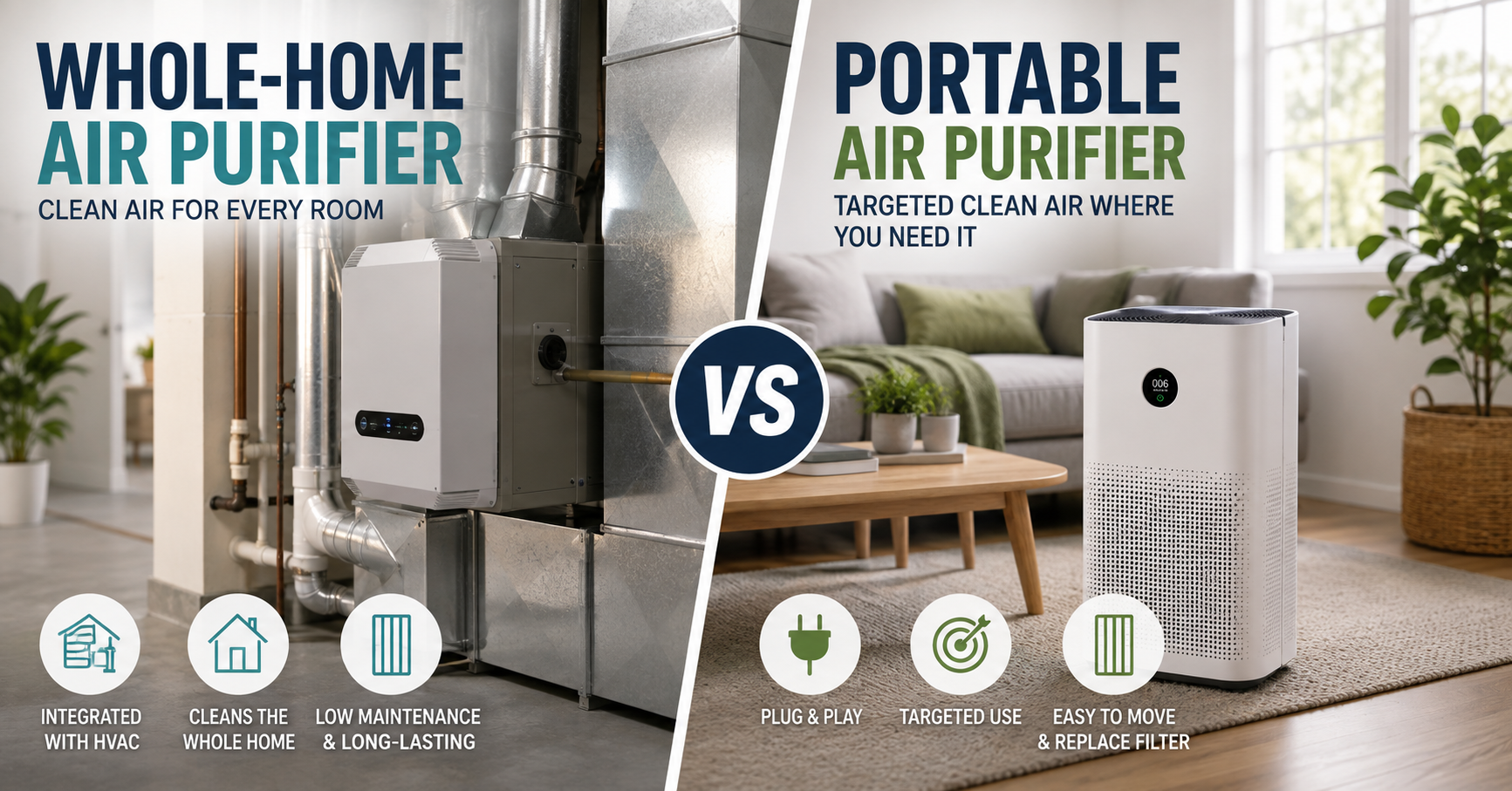
A whole-home air purifier is designed to clean air throughout multiple rooms, while a portable air purifier is designed to clean the air in one room or a smaller area. The better option depends on your home’s size, HVAC system, budget, and where you need cleaner air most.
A whole-home purifier works with your central HVAC system. As the HVAC system moves air through the ductwork, the purifier filters that air.
A portable purifier works on its own. You plug it in and place it in the room where you want better air filtration.
If you want whole-home coverage, a central HVAC-based system may make more sense. If you only need to improve the air in a bedroom, office, or other specific room, a portable unit is usually simpler and less expensive.
The key is to choose the option that matches the area you want to treat and the type of air-quality problem you’re trying to address.
Whole-Home Air Purifier vs Portable Air Purifier: What’s the Difference?
The main difference is coverage: a whole-home air purifier works with your HVAC system to filter air throughout the home, while a portable purifier cleans the air in a specific room.
A whole-home purifier is installed in or connected to your central HVAC system. As the HVAC system moves air through the ductwork, the air passes through the purifier before returning to the living spaces.
A portable air purifier works independently. It uses its own fan to pull air through a filter and then circulates the filtered air back into the room.
Here’s how the two options compare:
| Feature | Whole-Home Air Purifier | Portable Air Purifier |
| Coverage | Multiple rooms or the whole home | One room or specific area |
| Installation | May require HVAC installation | Plug in and use |
| Upfront cost | Usually higher | Usually lower |
| Portability | Not portable | Easy to move |
| Works without HVAC | Typically depends on HVAC airflow | Yes |
| Best for | Broad home-wide filtration | Targeted room filtration |
A whole-home purifier makes more sense when you want broader coverage, while a portable unit is more practical when you only need to clean the air in one or two rooms.
Keep in mind that whole-home filtration depends on your HVAC system moving air. A portable purifier can keep filtering a room independently of the central HVAC system.
How Does a Whole-Home Air Purifier Work?
A whole-home air purifier cleans air as it moves through your central HVAC system, allowing one system to filter air across multiple rooms.
The purifier is usually installed in the HVAC system or connected to the ductwork. When the HVAC system runs, it pulls air from the home and sends it through the filtration or purification equipment. The cleaner air then moves back through the ductwork and into the living spaces.
This setup can provide broader coverage without putting a separate air purifier in every room.
However, a whole-home purifier can only filter air that passes through the HVAC system. If the system isn’t running, it may filter little or no air, depending on the type of purifier and how it’s installed.
How well it works also depends on the air purification technology, HVAC airflow, system design, and regular maintenance. A properly sized and maintained system will generally perform better than one with poor airflow or an overdue filter change.
If you’re considering a whole-home purifier, make sure the equipment is compatible with your HVAC system and can provide the level of filtration you need without causing excessive airflow resistance.
How Does a Portable Air Purifier Work?
A portable air purifier cleans the air in a specific room by pulling air through a filter and circulating the filtered air back into the room.
A built-in fan draws room air into the unit. The air then passes through one or more filters before the purifier releases it back into the room.
Many portable purifiers use HEPA filters to capture airborne particles and can provide targeted filtration in bedrooms and other frequently used rooms. Some also use activated carbon filters to help reduce certain gases and odors.
When choosing a portable purifier, pay attention to its clean air delivery rate (CADR). CADR indicates how quickly the unit can deliver filtered air, and a higher CADR is generally better suited to a larger room.
Room size and placement also matter. A portable purifier mainly cleans the room where you place it, rather than automatically cleaning the entire house.
For the best results, choose a unit rated for the room’s size and place it where air can move freely around the purifier. Avoid blocking the intake or exhaust with furniture, curtains, or other objects.
Which Is Better: Whole-Home or Portable Air Purifier?
A whole-home air purifier is better when you want filtration across multiple rooms, while a portable air purifier is better for one room, lower upfront cost, and flexibility. The right choice depends on your HVAC system, home size, budget, and where you need cleaner air.
Choose a Whole-Home Air Purifier If:
Choose a whole-home air purifier if you have central HVAC and want one system to provide filtration across multiple rooms.
A whole-home system may be a good fit if you:
- Have a central HVAC system.
- Want broader coverage throughout the house.
- Don’t want multiple portable units.
- Prefer an integrated solution.
- Are already planning HVAC installation, replacement, or upgrades.
- Want filtration without using floor or table space in each room.
For a larger home, a whole-home system can be more convenient than buying and maintaining several portable units.
However, the system must be properly matched to your HVAC equipment. It also relies on the HVAC system moving air through the home.
Choose a Portable Air Purifier If:
Choose a portable air purifier if you mainly need cleaner air in one room or want a simple system you can move as needed.
A portable unit may be the better option if you:
- Only need filtration in one room.
- Live in a rental.
- Don’t have central HVAC.
- Want a lower upfront cost.
- Want to move the purifier between rooms.
- Need extra filtration in a bedroom or home office.
For portable units, check the CADR and make sure it’s appropriate for the room size. A purifier with a higher CADR can move and clean more air, making it better suited to larger spaces.
Quick Decision
Choose a whole-home purifier for broad coverage and a portable purifier for targeted filtration.
If you already have central HVAC and want to treat multiple rooms, a whole-home system is worth considering. If you’re unsure which option fits your HVAC system and home’s needs, indoor air services can help evaluate your filtration needs. If you only need cleaner air in one or two rooms, a properly sized portable purifier is usually simpler and more flexible.
Whole-Home Air Purifier vs Portable: Pros and Cons
Whole-home air purifiers provide broader coverage, while portable air purifiers are easier to install, move, and use in a specific room. Each option has advantages and drawbacks. Air purification isn’t the only way to address indoor-air concerns. If you’re comparing different HVAC air-cleaning technologies, see UV lights vs. air purifiers.
Whole-Home Air Purifier Pros
The biggest benefit of a whole-home purifier is that it can provide filtration across multiple rooms through the central HVAC system.
- Covers multiple rooms instead of just one
- Works with a central HVAC system
- Doesn’t take up floor or table space
- Avoids placing separate purifiers in different rooms
- Provides an integrated filtration setup
Whole-Home Air Purifier Cons
The main drawbacks are higher upfront costs, installation requirements, and dependence on the HVAC system.
- Usually costs more upfront
- May require professional HVAC installation
- Depends on HVAC airflow to circulate and filter air
- Less practical if you only need to clean one room
- Requires regular filter and system maintenance
Portable Air Purifier Pros
The biggest advantage of a portable purifier is its flexibility; you can set it up in the room where you need cleaner air and move it whenever needed.
- Easy to set up
- Usually costs less upfront
- Can be moved between rooms
- Doesn’t require HVAC installation
- Works independently of the central HVAC system
- Useful for targeted room filtration
Portable Air Purifier Cons
The main limitation of a portable purifier is its coverage, since each unit is designed for a specific room or area.
- Usually treats one room at a time
- Takes up floor or table space
- Multiple rooms may require multiple units
- Filters need regular replacement
- Fan noise can be noticeable at higher speeds
- Coverage depends on the unit’s CADR and room size
In simple terms, choose whole-home filtration for broader coverage and a portable purifier when you value flexibility and targeted cleaning.
Which Air Purifier Costs More?
A whole-home air purifier usually costs more upfront than a portable air purifier because it may require HVAC installation and additional equipment. A portable unit typically has a lower initial cost and can be used as soon as you set it up.
But the purchase price isn’t the only cost to consider.
Whole-Home Air Purifier Costs
A whole-home system can have higher upfront and installation costs, but one system can provide filtration across multiple rooms.
Consider:
- Purifier or filtration equipment
- Professional installation
- Replacement filters
- HVAC maintenance
- Ongoing energy use
The actual cost depends on the type of system, your existing HVAC setup, and the installation required.
Portable Air Purifier Costs
A portable purifier usually costs less to get started, but you may need more than one unit to cover multiple rooms.
Consider:
- Purifier purchase price
- Replacement filters
- Electricity use
- Number of units needed
A single portable unit can be a cost-effective choice if you only need to clean one room. But buying several units for bedrooms, living areas, and other spaces can increase the total cost.
The better value depends on the coverage you need. Compare the total cost of providing the level of filtration you want rather than comparing the price of one portable unit with one whole-home system.
Can a Portable Air Purifier Clean an Entire House?
A single portable air purifier usually cannot clean an entire house effectively because it is designed to treat a specific room or area. Its performance depends on the unit’s CADR, room size, layout, and how easily air moves between spaces.
Air doesn’t move evenly throughout most homes. Walls, closed doors, furniture, and separate rooms can limit how much filtered air reaches other areas.
For example, placing a powerful portable purifier in the living room doesn’t mean it will provide the same level of filtration in a bedroom at the other end of the house.
A larger unit with a higher clean air delivery rate (CADR) can handle a larger room, but it still has a practical coverage area. EPA recommends choosing a portable air cleaner based on its CADR and the size of the room or area you want to treat.
If you want to clean the air in several rooms, you may need multiple portable purifiers, with each unit sized appropriately for the room where it will operate.
For consistent filtration across multiple rooms, a whole-home air purifier connected to a central HVAC system may be a more practical option.
Can a Whole-Home Air Purifier Replace a Portable Air Purifier?
A whole-home air purifier can reduce the need for portable units, but it may not completely replace one in every situation. A whole-home system provides broader filtration through the central HVAC system, while a portable unit lets you target a specific room.
A whole-home purifier can be a good fit when you want consistent filtration throughout multiple rooms. It eliminates the need to place separate units around the house.
However, a portable purifier can still be useful when one area needs additional filtration.
For example, you might use a portable purifier in:
- Bedroom: For extra filtration while you sleep
- Home office: When you spend several hours in one room
- Nursery: When you want targeted filtration in a child’s room
- Smoke-affected room: When smoke is entering or accumulating in a specific area
- High-particle area: When one room has more dust or airborne particles than the rest of the home
Using both can make sense when you want broad whole-home filtration plus extra cleaning in a specific room. The whole-home system handles general filtration, while the portable unit provides additional, targeted coverage where you need it most.
Which Is Better for Allergies, Dust, and Smoke?
Both whole-home and portable air purifiers can reduce airborne particles and help improve your home’s indoor air quality, but the better choice depends on where the particles are coming from and how much of your home you want to treat.
For Allergies
A portable HEPA air purifier can be a good choice for targeted allergy-related filtration, while a whole-home system can provide broader coverage.
A portable unit can make sense in a bedroom or other room where you spend a lot of time. A whole-home system can help filter particles that pass through the central HVAC system across multiple rooms.
EPA notes that portable air cleaners and HVAC filtration can help improve indoor air quality, although their effect on allergy and asthma symptoms can vary from person to person.
If allergies are your main concern, focus on particle filtration performance, room coverage, and CADR rather than choosing a purifier based only on its marketing claims. If you’re also comparing HVAC filtration options, see HEPA vs. standard HVAC filters for a closer look at the differences.
For Dust
A whole-home air purifier is more practical when airborne dust is spread across multiple rooms, while a portable unit is better when dust is mainly a problem in one area.
Filtration can help capture airborne dust, but it won’t remove dust that has already settled on floors, furniture, or other surfaces.
If your home has unusually high dust levels, it’s also important to address the source. Construction, gaps in the building envelope, dirty ductwork, or other issues may contribute to excessive dust.
For Smoke and Fine Particles
A properly sized portable air purifier can be especially useful when you need stronger filtration in one room during a smoke event.
A whole-home system can also filter smoke particles that pass through the HVAC system, providing broader coverage.
For portable units, check the CADR and room size rather than looking only at the filter type. A higher CADR generally means the purifier can clean more air in a given period, making it better suited to a larger room.
If smoke is a persistent problem, don’t rely on filtration alone. Reduce the source when possible and use appropriate ventilation when outdoor air conditions are safe.
Whole-Home vs Portable Air Purifier: Which Should You Choose?
Choose a whole-home air purifier if you want broader filtration through your central HVAC system, and choose a portable purifier if you need targeted filtration in one or two rooms.
Use this quick guide to narrow down your choice:
| Your Situation | Better Choice |
| You want filtration across multiple rooms | Whole-home |
| You only need to clean one room | Portable |
| You rent your home | Portable |
| You have central HVAC | Whole-home may be a good fit |
| You want a lower upfront cost | Portable |
| You want to move the purifier between rooms | Portable |
| You prefer an integrated system | Whole-home |
| You need extra filtration in one bedroom | Portable |
If you have central HVAC and want consistent filtration across several rooms, a whole-home system is worth considering. It provides broader coverage without requiring separate units throughout the house.
If you only need cleaner air in one or two rooms, a portable purifier is usually the simpler and more flexible option. Choose a unit with a CADR appropriate for the room size to make sure it can move enough air.
Frequently Asked Questions
Is a whole-home air purifier better than a portable one?
A whole-home air purifier is better for broader coverage, while a portable purifier is better for targeted filtration in a specific room. The right choice depends on your HVAC system, home size, budget, and filtration needs.
Is a portable air purifier enough for a whole house?
One portable air purifier usually isn’t enough to effectively clean an entire house. Most portable units are designed for a specific room or area, so you may need multiple units for several rooms.
Does a whole-home air purifier work when the HVAC is off?
A whole-home purifier generally filters less air when the HVAC system isn’t running. Most systems rely on the HVAC blower to move air through the purifier, although operation can vary by system design.
Are whole-home air purifiers worth the cost?
A whole-home air purifier can be worth the cost if you want broader filtration and have a compatible central HVAC system. If you only need to clean one room, a portable purifier may be more practical and less expensive.
Do portable air purifiers use more electricity?
Portable air purifier energy use depends on the unit’s power consumption, fan speed, and how long it runs. Higher fan speeds generally use more electricity because the fan moves more air.
Can I use a whole-home and portable air purifier together?
Yes, using both can make sense when you want broad filtration plus extra cleaning in a specific room. For example, a portable unit can provide additional filtration in a bedroom while the whole-home system handles broader coverage.
Which is better for allergies, whole-home or portable?
A portable HEPA purifier can be useful for targeted filtration in a bedroom or other frequently used room, while a whole-home system provides broader coverage. Choose based on where you need filtration and how much of the home you want to treat.
How many portable air purifiers do I need for my home?
The number depends on your home’s size, room layout, and each purifier’s CADR. Match each unit’s CADR and recommended coverage to the room where you plan to use it rather than assuming one unit can effectively cover the entire home.
Final Takeaway
A whole-home air purifier is usually the better choice for broad coverage, while a portable air purifier is better for targeted filtration in specific rooms.
Choose a whole-home system if you have central HVAC and want one integrated system to filter air across multiple rooms. Choose a portable unit if you only need to clean one room, want something you can move, or don’t want to modify your HVAC system.
Before buying, look beyond the marketing claims. For a portable purifier, check the CADR and recommended room size. For a whole-home system, consider HVAC compatibility, airflow, filter performance, installation, and maintenance.
Also remember that an air purifier is only one part of good indoor air quality. Reducing pollution sources and bringing in clean outdoor air when conditions allow are important too. Filtration works best as part of an overall approach to cleaner indoor air.