

Mini Split vs Window AC: Which Is Better for Your Home?
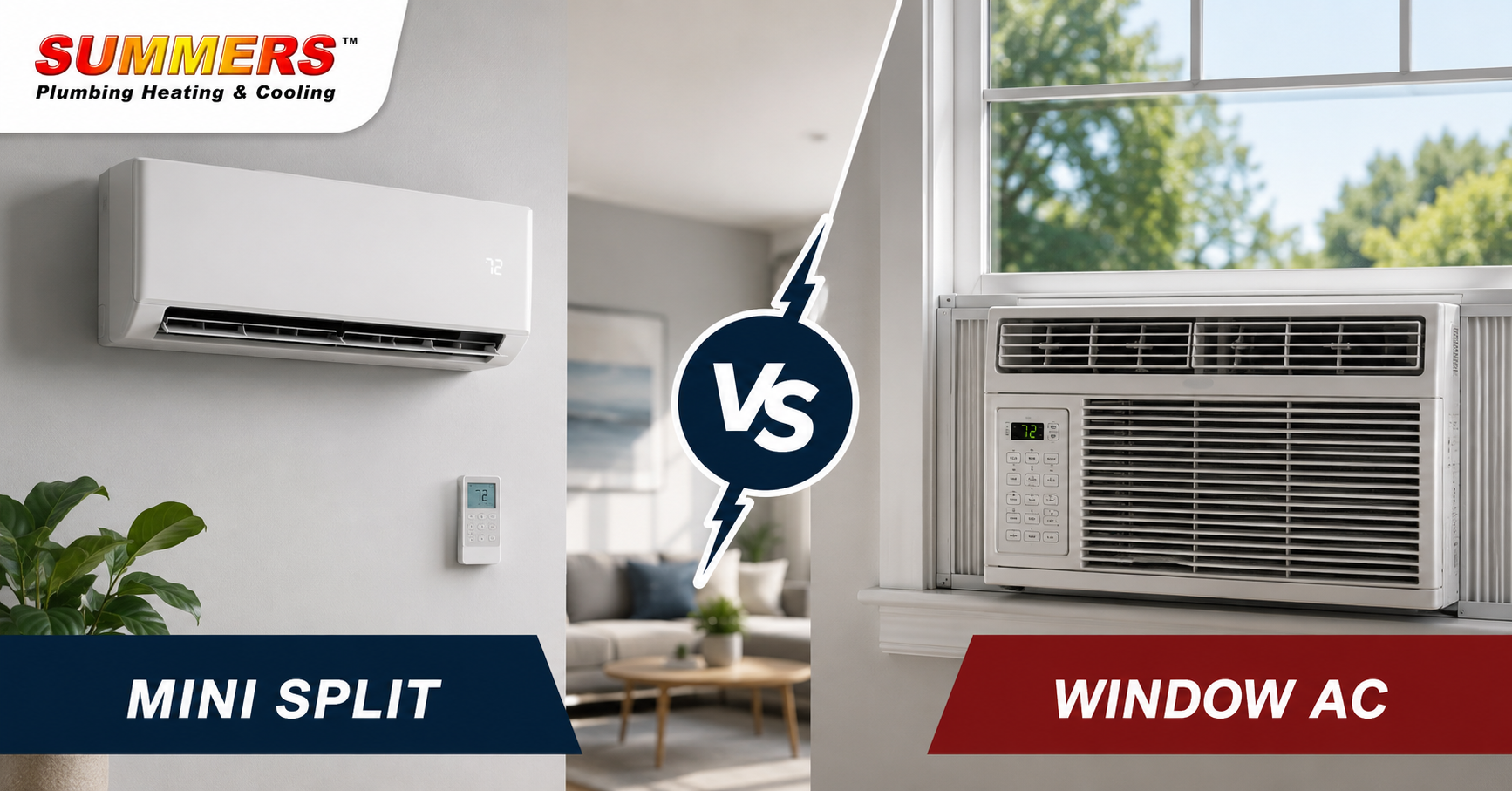
A mini split usually offers better efficiency, quieter operation, and more precise temperature control than a window AC, while a window AC costs less upfront and works well for cooling a single room.
Both systems can cool a room effectively. The better choice depends on your budget, how often you use the system, room size, installation needs, and long-term comfort.
If you own your home and want a permanent cooling solution, a mini split often makes more sense. If you need affordable cooling for one room or a temporary solution, a window AC may be the better fit.
Mini Split vs Window AC: What’s the Difference?
A mini split separates the indoor and outdoor components, while a window AC combines the main cooling components in one unit installed through a window or wall opening.
A mini split uses an outdoor compressor connected to an indoor air handler through refrigerant lines. The indoor unit distributes cooled air directly into the room.
A window AC contains the compressor, condenser, evaporator, and fan in one cabinet. You install the unit in a window or a suitable wall opening.
This basic design difference affects noise, installation, efficiency, appearance, and how each system distributes cool air. If you’re also comparing ductless systems with traditional central cooling, see our guide to central air vs. mini split.
Mini Split vs Window AC Compared
A mini split generally provides better comfort, quieter operation, and more installation flexibility, while a window AC usually offers a lower upfront cost and simpler installation.
| Factor | Mini Split | Window AC |
| Upfront cost | Higher | Lower |
| Installation | More involved | Simpler |
| Energy efficiency | Usually higher | Varies by model |
| Indoor noise | Usually quieter | Usually louder |
| Temperature control | More precise | Basic |
| Window obstruction | None | Blocks part of window |
| Portability | Low | Easier to move |
| Multiple rooms | Multi-zone options available | Usually one room |
| Appearance | Less window obstruction | Visible in window |
| Long-term use | Good option | Good for simpler needs |
Your specific results depend on the equipment you choose and how you use it.
Which Uses Less Electricity: Mini Split or Window AC?
A mini split often uses less electricity than a comparable window AC, especially when the mini split uses an inverter compressor and has a higher efficiency rating.
Mini splits can adjust compressor speed based on the cooling demand. Instead of repeatedly switching fully on and off, an inverter system can reduce its output when the room needs less cooling.
When comparing models, look at their efficiency ratings rather than assuming one type always costs less to run.
Consider:
- SEER2 rating
- EER or EER2 rating
- Cooling capacity
- Room size
- Outdoor temperature
- Thermostat setting
- Daily operating hours
- Local electricity rates
A highly efficient window AC can still use less electricity than a poorly selected or oversized mini split.
Which Cools Better: Mini Split or Window AC?
A mini split usually provides more even and consistent cooling, while a window AC works best when you need to cool one room.
A mini split’s indoor air handler can distribute cool air across the room without placing the entire cooling system inside the window.
A window AC also cools a room effectively when you select the correct capacity and provide good airflow. However, its location can make temperature distribution less even in larger or unusually shaped rooms.
For either system, proper sizing matters.
A unit that’s too small may struggle to keep up with the heat entering the room. A unit that’s too large may cycle too frequently and may not remove humidity as effectively.
Which Is Quieter: Mini Split or Window AC?
A mini split is usually quieter inside the room because it places the compressor and condenser outdoors.
With a mini split, you mainly hear the indoor fan and airflow from the wall-mounted air handler.
A window AC keeps the compressor and other mechanical components in the same cabinet as the indoor airflow section. That can make the unit more noticeable while it operates.
This difference can matter in:
- Bedrooms
- Home offices
- Nurseries
- Living rooms
- Other quiet spaces
However, noise varies by model. Always check the manufacturer’s published sound ratings when noise matters to you.
Which Is Cheaper: Mini Split or Window AC?
A window AC usually costs less upfront, while a mini split requires a larger initial investment but may provide better efficiency and comfort over time.
A window AC typically needs less installation work. You place it in a suitable window or wall opening and connect it to electrical power according to the manufacturer’s requirements.
A mini split requires more installation work. The technician must mount the indoor and outdoor units, connect the refrigerant lines, handle condensate drainage, and complete the required electrical connections.
Your total cost depends on the equipment, installation, electrical work, and any modifications your home needs.
Don’t compare only the purchase price. Consider how long you plan to use the system and how much cooling you need.
Which Is Easier to Install?
A window AC is generally easier to install, while a mini split requires more planning and professional installation.
A window AC usually involves:
- A suitable window opening
- Secure mounting
- Weather sealing
- Electrical connection
- Proper drainage
A mini split requires:
- Indoor-unit placement
- Outdoor-unit placement
- Refrigerant-line installation
- Condensate drainage
- Electrical connections
- Proper commissioning
A qualified HVAC professional should handle the refrigerant work and other installation tasks that require specialized equipment or knowledge.
Which Is Better for a Bedroom?
A mini split is usually better for a bedroom when quiet operation, precise temperature control, and comfortable airflow matter most.
The outdoor compressor keeps much of the operating noise outside.
You can also position the indoor unit to distribute air across the bedroom without blowing directly onto the bed.
A window AC can still work well in a bedroom, especially when upfront cost matters more than noise or appearance.
If you choose a window AC, look for a model with a suitable noise rating and place it where the airflow can reach the room effectively.
Which Is Better for a Large Room?
A mini split is generally a better choice for a larger room because it can provide strong airflow and more consistent cooling without occupying the window opening.
However, don’t choose the system based only on room size.
The cooling load also depends on:
- Insulation
- Windows
- Ceiling height
- Sun exposure
- Number of occupants
- Heat-producing appliances
- Local climate
A properly sized system matters more than simply choosing the largest available unit.
For unusually large or open spaces, an HVAC professional can calculate the cooling load and recommend the appropriate capacity.
When Is a Window AC the Better Choice?
A window AC makes more sense when you need affordable, straightforward cooling for one room.
A window unit can be a practical choice when:
- You’re renting
- Your budget is limited
- You need temporary cooling
- You only need to cool one room
- You already have a suitable window
- You don’t want permanent HVAC installation
Window ACs also make sense when you don’t use the room frequently enough to justify the higher upfront cost of a mini split.
When Is a Mini Split the Better Choice?
A mini split makes more sense when you want quieter operation, better efficiency, precise temperature control, or long-term cooling for a frequently used space.
Consider a mini split when:
- You own the home
- You use the room every day
- Noise matters
- Energy efficiency matters
- You don’t want to block a window
- You want more precise temperature control
- You need cooling in a larger room
- You may want multi-zone cooling later
A multi-zone mini split can also serve multiple rooms with several indoor units connected to one outdoor system.
Mini Split vs Window AC: Pros and Cons
Mini splits offer stronger comfort and efficiency, while window ACs offer lower upfront costs and simpler installation.
Pros and Cons of Mini Split
Pros:
- Quieter indoor operation
- Generally higher efficiency
- Better temperature control
- Doesn’t block a window
- Flexible indoor-unit placement
- Multi-zone options
- Good long-term solution
Cons:
- Higher upfront cost
- More involved installation
- Professional installation usually needed
- Less convenient to move
- Requires indoor and outdoor space
Window AC Pros and Cons
Pros:
- Lower upfront cost
- Simple installation
- Good for one room
- Easy to replace
- Easier to remove when needed
Cons:
- Blocks part of a window
- Usually louder indoors
- Limited to the room where you install it
- Less flexible placement
- Can affect window access
- May require seasonal removal in some climates
Frequently Asked Questions
Is a mini split better than a window AC?
A mini split is usually better when you prioritize quiet operation, efficiency, comfort, and long-term use, while a window AC is better when upfront cost and simple installation matter most.
Neither system works best for every home.
Consider how often you use the room, your budget, the room size, and how long you plan to keep the system.
Is a mini split cheaper to run than a window AC?
A mini split can cost less to operate than a window AC when it has a higher efficiency rating and provides the right amount of cooling for the space.
Actual operating costs depend on the equipment, electricity rate, outdoor temperature, thermostat setting, and how often you run the system.
Compare the efficiency ratings of the specific models you’re considering rather than relying on the system type alone.
Does a mini split cool better than a window AC?
A mini split generally provides more even cooling, especially in larger rooms, but a properly sized window AC can cool a single room effectively.
The system’s capacity, placement, insulation, and airflow all affect cooling performance.
Which lasts longer, a mini split or window AC?
A properly installed and maintained mini split will often last longer than a typical window AC, but actual lifespan varies by equipment quality, usage, maintenance, and operating conditions.
Don’t choose between the two based on lifespan alone. Consider the total cost, installation, efficiency, and how you plan to use the system.
Can a mini split replace a window AC?
Yes, a mini split can replace a window AC for many single-room cooling applications.
A mini split usually requires a larger upfront investment and more involved installation, but it can provide quieter operation, better efficiency, and more flexible placement. If you’re considering replacing a window AC with a mini split, professional mini split installation can help ensure the system is properly sized and installed.
Is a mini split worth it for one room?
A mini split can be worth the higher upfront cost when you use the room frequently and value quiet operation, efficiency, and long-term comfort.
For occasional or temporary cooling, a window AC may provide enough cooling at a much lower initial cost.
Final Thought
Choose a mini split if you prioritize efficiency, quiet operation, comfort, and long-term use; choose a window AC if you want lower upfront cost and simple cooling for one room.
A mini split may be the better choice when:
- You own the home
- You use the room frequently
- Quiet operation matters
- Energy efficiency matters
- You want better temperature control
- You want a permanent cooling solution
A window AC may be the better choice when:
- Budget is your main concern
- You rent your home
- You need temporary cooling
- You only need to cool one room
- You want a simpler installation
The best choice comes down to how you use the space and what matters most to you. For long-term comfort and efficiency, a mini split usually has the advantage. For low-cost, simple room cooling, a window AC often makes more sense.