

Kitchen Faucet vs Bathroom Faucet: Key Differences
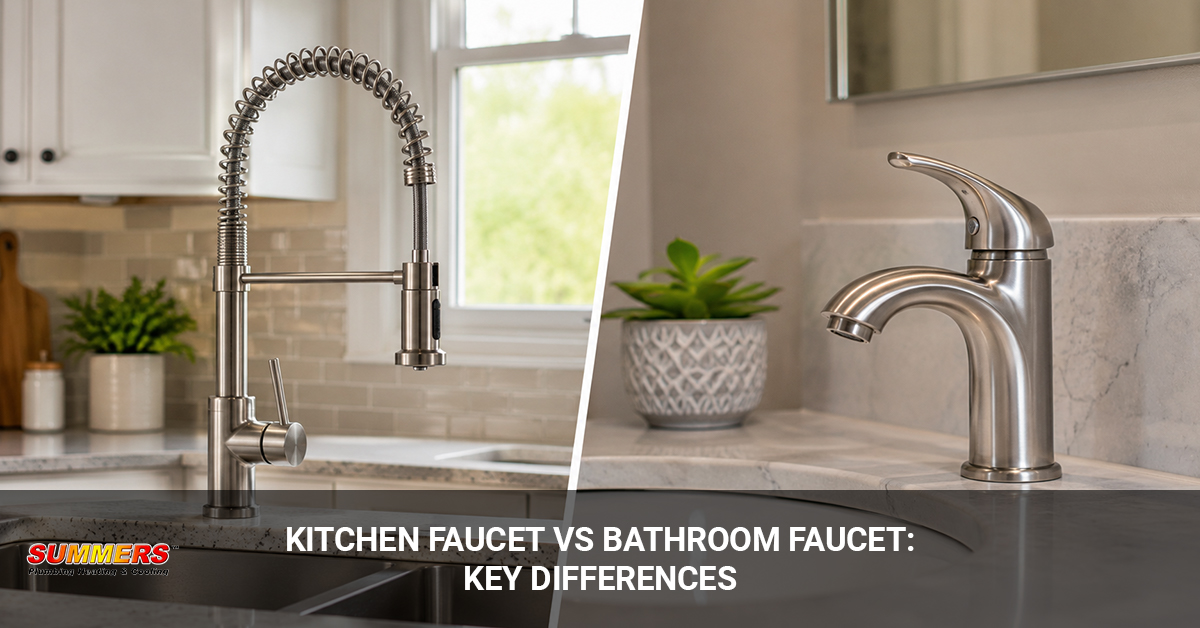
Kitchen faucets are generally larger, taller, and designed for deeper sinks and tasks like washing dishes and filling pots, while bathroom faucets are usually smaller and designed for handwashing.
Although they may look similar, kitchen and bathroom faucets aren’t always interchangeable. Their size, spout reach, mounting configuration, and features are often different.
The best choice depends on the sink you’re installing it on and how you plan to use it.
Kitchen Faucet vs Bathroom Faucet: What’s the Difference?
The main difference between a kitchen and bathroom faucet is their size, reach, design, and intended use.
Kitchen faucets are built around larger, deeper sinks. They often have taller spouts and features such as pull-down sprayers.
Bathroom faucets are usually more compact. They’re designed for shallower basins and everyday tasks such as washing your hands and brushing your teeth.
| Feature | Kitchen Faucet | Bathroom Faucet |
| Size | Usually larger | Usually smaller |
| Spout reach | Generally longer | Generally shorter |
| Height | Often taller | Usually lower |
| Sink | Deeper and larger | Smaller and shallower |
| Sprayer | Common | Less common |
| Main use | Washing, rinsing, filling | Handwashing and personal use |
| Mounting | Varies | Varies |
These are general differences. Some faucets are designed with features that blur the line between the two.
Are Kitchen and Bathroom Faucets Interchangeable?
Kitchen and bathroom faucets aren’t always interchangeable because sink holes, faucet dimensions, spout reach, and water connections can differ.
Even if a faucet physically looks like it could fit, check the sink before buying it.
A faucet that’s too tall can look out of place or create clearance problems in a bathroom.
A faucet with a short spout may not reach far enough into a kitchen sink.
The mounting configuration also matters.
Kitchen Faucet vs Bathroom Faucet Size
Kitchen faucets are generally larger than bathroom faucets because they need to provide more clearance and reach inside deeper sinks.
The difference is particularly noticeable when comparing a pull-down kitchen faucet with a standard bathroom faucet.
Faucet Height
Kitchen faucets often have taller spouts to provide clearance for large pots, pans, and other items, while bathroom faucets generally have a lower profile.
A taller faucet can be useful in a kitchen because you may need to fill a large container or wash bulky items.
In a bathroom, excessive height can cause water to splash against a small basin or countertop.
Always consider the sink’s depth and the faucet’s height together.
Spout Reach
Kitchen faucets generally have longer spouts because they need to reach farther into larger sinks, while bathroom faucets typically have shorter spouts.
The spout should direct water toward the center of the sink.
A faucet with insufficient reach can make everyday tasks frustrating.
A faucet with too much reach can send water toward the front edge of a bathroom basin and cause splashing.
Sink Size and Depth
Kitchen faucets are designed for deeper and larger sinks, while bathroom faucets are usually matched with smaller, shallower basins.
This is one of the most important differences when choosing a faucet.
A kitchen sink may need enough clearance for:
- Large pots
- Dishes
- Containers
- Food preparation
A bathroom sink generally doesn’t require that much space.
Kitchen Faucet vs Bathroom Faucet Features
Kitchen faucets usually offer more features for washing and rinsing, while bathroom faucets tend to focus on simple water control and compact design.
That doesn’t mean bathroom faucets can’t have advanced features.
It simply reflects how each faucet is typically used.
Pull-Down and Pull-Out Sprayers
Pull-down and pull-out sprayers are common on kitchen faucets because they make rinsing dishes and cleaning the sink easier.
A pull-down sprayer can be pulled from the faucet and directed around the sink.
This is useful for:
- Rinsing dishes
- Cleaning the sink
- Washing vegetables
- Filling containers
Sprayers are less common on traditional bathroom faucets because most bathroom sinks don’t require that range of movement.
Single-Handle vs. Two-Handle Designs
Both kitchen and bathroom faucets can use either single-handle or two-handle designs.
A single-handle faucet lets you control water temperature and flow with one lever.
A two-handle faucet uses separate controls for hot and cold water.
The choice is mostly about preference, sink configuration, and the style of installation.
Handle design alone doesn’t determine whether a faucet is intended for a kitchen or bathroom.
Touchless and Specialty Features
Touchless and other specialty faucet features are available for both kitchens and bathrooms, but their usefulness depends on how the fixture will be used.
Touchless faucets can be convenient in kitchens when your hands are dirty while cooking.
They can also be useful in bathrooms for reducing the need to touch the handle.
Consider the feature based on your needs rather than assuming one type is better.
Kitchen Faucet vs Bathroom Faucet Installation
Kitchen and bathroom faucets install in similar ways, but the sink’s mounting configuration and plumbing connections determine whether a particular faucet will fit.
Before installation, check:
- Number of mounting holes
- Hole spacing
- Faucet mounting type
- Supply connections
- Available countertop space
- Sink clearance
If you’re replacing a faucet, professional faucet installation can help ensure the new fixture fits properly and the connections are secure.
A single-hole faucet won’t automatically fit a sink designed for a three-hole configuration unless the installation setup allows for it.
Single-Hole Faucets
Single-hole faucets mount through one opening and are common in both kitchens and bathrooms.
They can create a clean appearance and are relatively straightforward to install when the sink is designed for them.
Three-Hole Faucets
Three-hole faucets use separate mounting openings and may have a deck plate or separate hot and cold handles.
They’re common in traditional bathroom sink designs and are also available for kitchen installations.
Widespread Bathroom Faucets
Widespread bathroom faucets use separate hot and cold handles and a separate spout, allowing more flexibility in the spacing.
They’re designed primarily for bathroom sinks and countertops.
They generally aren’t the first choice for kitchen sinks because kitchen faucet designs tend to prioritize reach and sink coverage.
Can You Install a Kitchen Faucet in a Bathroom Sink?
You can install a kitchen faucet in some bathroom sinks if the mounting holes, dimensions, water connections, and available clearance are compatible.
However, compatibility isn’t the only consideration.
A large kitchen faucet may be too tall or have too much reach for a small bathroom basin.
Before installing one, check:
- Mounting-hole configuration
- Faucet height
- Spout reach
- Sink depth
- Countertop clearance
- Water connections
If the faucet extends too far over the basin, water may splash onto the countertop or floor.
Can You Install a Bathroom Faucet in a Kitchen Sink?
A bathroom faucet can work in some kitchen sinks if the mounting configuration, spout reach, height, and water connections are compatible.
The biggest issue is often reach.
A short bathroom faucet may not direct water toward the useful part of a large kitchen sink.
It may also provide less clearance for washing large pots and containers.
For most kitchens, a faucet designed for kitchen use is the more practical option.
Kitchen Faucet vs Bathroom Faucet Water Flow
Kitchen faucets are generally designed to provide useful flow and reach for washing dishes and filling containers, while bathroom faucets are designed primarily for handwashing and everyday use.
However, don’t assume that every kitchen faucet has higher water flow than every bathroom faucet.
Actual flow depends on the specific model and its flow-control components.
An aerator or flow restrictor can also affect how much water comes out of the faucet.
If you’re comparing two specific faucets, check their manufacturer-listed flow rates rather than relying on the room they’re designed for.
Kitchen Faucet vs Bathroom Faucet Cost
Kitchen faucets generally cost more than basic bathroom faucets because they often have larger bodies, longer spouts, sprayers, and additional features.
Typical purchase prices can vary considerably by brand and quality.
| Faucet | Typical Price Range |
| Basic bathroom faucet | 50–200 |
| Mid-range bathroom faucet | 150–400 |
| Basic kitchen faucet | 100–300 |
| Mid-range kitchen faucet | 200–600+ |
Premium kitchen and bathroom faucets can cost considerably more.
Installation is another expense to consider if you hire a plumber.
Which Faucet Is Better for a Kitchen?
A kitchen faucet with enough spout reach, height, and useful spray features is usually the best choice for a kitchen sink.
Consider these factors:
- Sink depth
- Spout reach
- Faucet height
- Pull-down or pull-out sprayer
- Handle style
- Countertop clearance
- Mounting configuration
The faucet should allow you to comfortably wash dishes, rinse the sink, and fill containers.
Which Faucet Is Better for a Bathroom?
A bathroom faucet with the correct size, mounting configuration, and spout reach is usually the best choice for a bathroom sink.
Consider:
- Sink size
- Countertop space
- Mounting holes
- Spout height
- Spout reach
- Handle configuration
- Water-saving features
The faucet should direct water into the basin without causing unnecessary splashing.
What to Check Before Buying Either Faucet
Before buying a kitchen or bathroom faucet, check the sink’s mounting holes, faucet dimensions, spout reach, water connections, and available clearance.
Check Mounting Holes
Check the number and spacing of the mounting holes in your sink or countertop before buying a faucet.
Common configurations include:
- Single-hole
- Three-hole
- Widespread
Some faucets include a deck plate that can cover additional holes.
Measure Spout Reach
Measure the faucet’s spout reach to make sure water will land in a useful position inside the sink.
This is particularly important when replacing a faucet with a different model.
A faucet that looks right in the store may not direct water toward the center of your sink.
Check Faucet Height
Check the faucet’s overall height and clearance before installation, especially if cabinets or shelves are located above the sink.
Kitchen faucets are often taller, so overhead clearance can matter.
Confirm Water Connections
Check the faucet’s supply connections and the existing shutoff valves to make sure they’re compatible.
If the connections are old or corroded, they may need attention before the new faucet can be installed.
Check Sink and Countertop Clearance
Make sure the faucet has enough clearance to operate without hitting the wall, backsplash, cabinet, or other fixtures.
This is especially important with tall kitchen faucets and pull-down sprayers.
Kitchen Faucet vs Bathroom Faucet: Which Should You Choose?
Choose a kitchen faucet for deeper sinks and tasks such as washing dishes, rinsing, and filling containers, and choose a bathroom faucet for smaller basins and everyday handwashing.
The intended room is a useful starting point, but compatibility is more important.
If a faucet fits the sink and provides the right reach, height, and water connections, it may work outside its typical application.
Still, using a faucet designed for the specific sink usually makes it easier to get the right size and functionality. If your existing faucet has leaks, corrosion, or other problems, faucet repair may be a better option than replacing the entire fixture. Before deciding between repair and replacement, learn the signs it’s time to replace your faucet.
Kitchen vs Bathroom Faucet FAQs
What’s the main difference between a kitchen and bathroom faucet?
Kitchen faucets are generally larger, taller, and have longer spouts, while bathroom faucets are usually smaller and designed for shallower sinks.
Can I use a kitchen faucet in a bathroom?
You can use a kitchen faucet in some bathrooms if it fits the sink’s mounting holes, dimensions, water connections, and available space. A large kitchen faucet may be impractical for a small bathroom sink.
Can I use a bathroom faucet in a kitchen?
A bathroom faucet can work in some kitchens if its mounting configuration, spout reach, height, and water connections are compatible. A short bathroom faucet may not reach far enough into a large kitchen sink.
Are kitchen faucets bigger than bathroom faucets?
Kitchen faucets are generally larger and taller than bathroom faucets because they are designed for deeper sinks and tasks requiring more clearance.
Do kitchen and bathroom faucets use the same connections?
Kitchen and bathroom faucets can use similar water supply connections, but compatibility depends on the specific faucet, supply lines, and installation configuration.
Are kitchen faucets more expensive than bathroom faucets?
Kitchen faucets are often more expensive than basic bathroom faucets because they may include larger designs, pull-down sprayers, and additional features.
Do kitchen faucets have higher water flow?
Kitchen faucets may have higher flow rates than some bathroom faucets, but flow depends on the specific model and its flow-control components. Check the manufacturer’s specifications when comparing faucets.
Can any faucet fit any sink?
No, a faucet must match the sink’s mounting holes, dimensions, water connections, and available clearance.
How do I know what size faucet I need?
Choose a faucet based on the sink’s mounting configuration, spout reach, faucet height, and basin size. The spout should direct water into a practical area of the sink without excessive splashing.
Should I choose a single-handle or two-handle faucet?
Choose a single-handle or two-handle faucet based on your preferred operation, sink configuration, and available mounting holes. Both styles can work well in kitchens and bathrooms.
Final Takeaway
The main differences between kitchen and bathroom faucets are their size, spout reach, height, features, and intended use.
Kitchen faucets are generally built for deeper sinks, larger items, and tasks such as washing and rinsing. Bathroom faucets are usually designed for smaller basins and everyday handwashing.
However, the room name on the faucet isn’t the only thing that matters. Before buying one, check the mounting holes, spout reach, height, water connections, and sink clearance.
Those measurements will tell you whether the faucet is actually compatible with your sink.