

AC Thermostat Problems That Look Like AC Failure
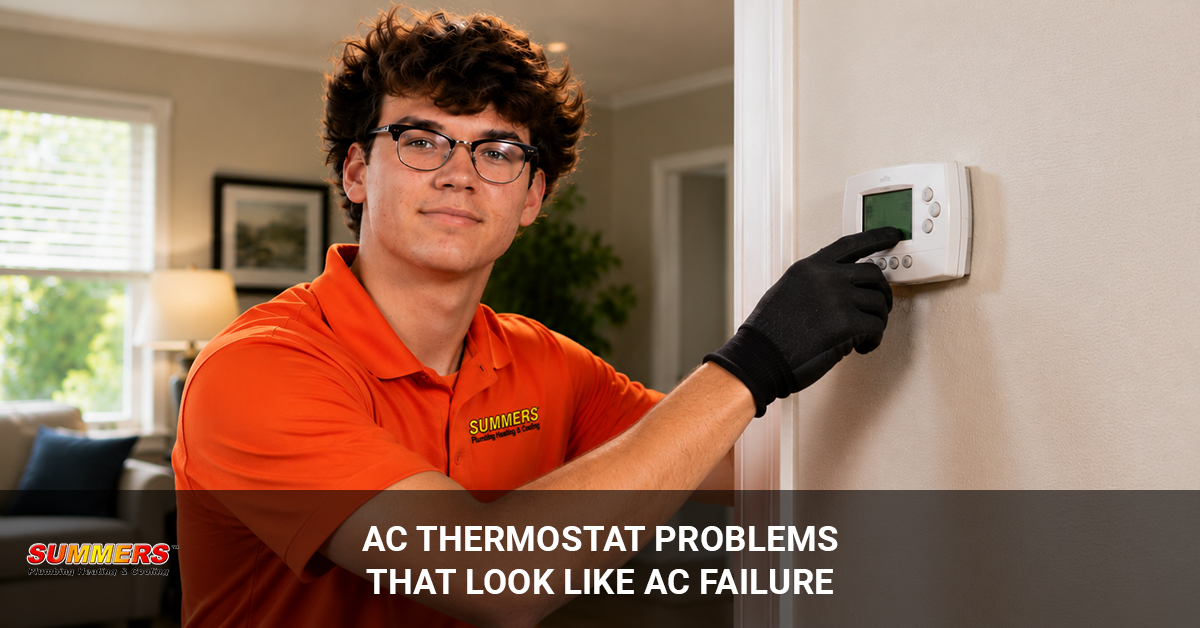
A faulty thermostat can make it seem like your air conditioner has stopped working, even when the AC itself is perfectly fine. Before you assume you need an expensive repair, it’s worth checking the thermostat first. In many cases, the problem is much simpler than you might think.
Your thermostat controls when your air conditioner turns on and off. If it’s not working correctly, your AC may not start, it may shut off too soon, or it may run without cooling your home properly. These symptoms can easily be mistaken for a failing air conditioner.
The good news is that many thermostat problems have simple solutions. Dead batteries, incorrect settings, dirty sensors, or a faulty thermostat can often be fixed without major repairs. Identifying the real cause early can save you time, money, and the frustration of an unnecessary service call.
In this guide, we’ll explain the most common thermostat problems that look like AC failure, how to troubleshoot them, and when it’s time to call an HVAC professional.
Can a Bad Thermostat Make It Seem Like Your AC Is Broken?
Yes, a bad thermostat can make it seem like your AC is broken even when the air conditioner is working properly. Since the thermostat controls when your cooling system turns on and off, even a small problem can prevent your AC from operating as it should.
For example, dead batteries can stop the thermostat from sending a signal to the AC. A faulty temperature sensor may think your home is already cool, causing the system to shut off too early. Incorrect settings, loose wiring, or a malfunctioning thermostat can also keep your AC from turning on or cooling your home properly.
That’s why it’s always a good idea to check the thermostat before assuming you need an expensive AC repair. In many cases, replacing the batteries, correcting the settings, or resetting the thermostat is all it takes to get your system working again.
How Does an AC Thermostat Work?
An AC thermostat works by monitoring your home’s temperature and telling your air conditioner when to turn on and off. It acts as the control center for your HVAC system, helping maintain the temperature you’ve selected.
When the room temperature rises above your thermostat setting, the thermostat sends a signal to your air conditioner to start cooling. Once your home reaches the desired temperature, it signals the system to shut off. This automatic process keeps your home comfortable while helping improve energy efficiency.
Modern digital and smart thermostats are more accurate than older manual models. Many also include helpful features such as programmable schedules, Wi-Fi connectivity, smartphone control, energy-saving modes, and, on compatible systems, humidity management.
Because the thermostat controls your entire cooling system, even a minor issue can affect your AC’s performance. If the thermostat isn’t reading the temperature correctly or isn’t communicating with the HVAC system, it can make it seem like your air conditioner has stopped working when the real problem is the thermostat itself.
10 AC Thermostat Problems That Look Like AC Failure
Many common thermostat problems can make it seem like your air conditioner has stopped working. Before you assume your AC needs an expensive repair, it’s worth checking the thermostat first. In many cases, the problem is simple to identify and inexpensive to fix.
1. Dead Thermostat Batteries
Dead thermostat batteries are one of the most common reasons an AC won’t turn on. Many digital thermostats rely on batteries to power the display and communicate with the HVAC system. When the batteries become weak or die, the thermostat may stop sending the signal that tells your air conditioner to start cooling.
Common signs include a blank thermostat screen, a low-battery warning, or an AC that won’t turn on even though the circuit breaker hasn’t tripped. In some cases, the display may still work, but the thermostat may not control the system correctly.
Fortunately, this is one of the easiest problems to fix. Replace the old batteries with fresh ones, then wait a few minutes to see if the thermostat reconnects with your HVAC system. If your AC starts working again, you’ve likely found the problem. To avoid unexpected issues, replace the batteries once a year or whenever your thermostat displays a low-battery warning.
2. Incorrect Thermostat Settings
Incorrect thermostat settings can make it seem like your AC has stopped working when it’s actually working as programmed. It’s more common than many homeowners realize. Someone may have accidentally changed the settings, or a smart thermostat schedule may have adjusted them automatically.
Before assuming there’s a problem with your air conditioner, make sure the thermostat is set to Cool mode, the temperature is lower than the current room temperature, and the fan is set to Auto instead of On. If you have a programmable or smart thermostat, also check that vacation mode, Eco Mode, or a cooling schedule isn’t preventing the system from running.
Taking a minute to review these settings can often solve the problem without the need for an HVAC repair.
3. A Faulty Temperature Sensor
A faulty temperature sensor can cause your thermostat to read the wrong room temperature and control your AC incorrectly. If the sensor thinks your home is cooler than it actually is, it may shut the air conditioner off too soon. If it reads a higher temperature than the room, the AC may run longer than necessary.
This can lead to uneven cooling, rooms that never reach the desired temperature, frequent short cycling, and higher energy bills. You may also notice that the temperature displayed on the thermostat doesn’t match how your home actually feels.
In some cases, the sensor can be recalibrated, but if it’s damaged or worn out, replacing the thermostat is often the best solution. An HVAC technician can test the sensor and confirm whether it’s reading the temperature accurately.
4. Loose or Damaged Thermostat Wiring
Loose or damaged thermostat wiring can prevent your thermostat from communicating with your air conditioner. Over time, wiring connections can loosen because of normal wear, vibration, corrosion, or accidental damage during previous repairs or renovations.
When this happens, your thermostat may lose power, display a blank screen, fail to start the AC, or cause the system to turn on and off unexpectedly. These symptoms often look like a major air conditioner problem, even though the issue is simply a faulty wiring connection.
Because thermostat wiring is connected to your HVAC system, it’s best to leave repairs to a qualified HVAC technician. They can safely inspect the wiring, repair damaged connections, and make sure the thermostat is communicating properly with your air conditioner.
5. The Thermostat Needs Calibration
A thermostat that isn’t properly calibrated can cause your AC to cool too much or not enough. When the thermostat displays the wrong temperature, it tells your air conditioner to turn on or off at the wrong time, making it seem like the AC isn’t working properly.
This issue is more common with older mechanical thermostats, but it can also affect digital models over time. You may notice that the temperature shown on the thermostat doesn’t match how the room actually feels, or that some areas of your home are consistently warmer or cooler than others.
An HVAC technician can test the thermostat to see if it’s reading the temperature accurately. If the thermostat can be recalibrated, that may solve the problem. However, if it’s outdated or no longer accurate, replacing it with a modern digital or smart thermostat is usually the better long-term solution.
6. The Thermostat Is Installed in the Wrong Location
A thermostat installed in the wrong location can give inaccurate temperature readings and affect your AC’s performance. To work properly, the thermostat needs to measure the average temperature inside your home. If it’s installed in direct sunlight, near a window, above a supply vent, or close to heat-producing appliances, it may not get an accurate reading.
For example, a thermostat exposed to direct sunlight may think your home is hotter than it really is, causing the AC to run longer than necessary. On the other hand, a thermostat located near a supply vent may cool down too quickly and shut the system off before the rest of the house reaches the desired temperature.
If some rooms feel comfortable while others stay too warm, the thermostat’s location could be part of the problem. An HVAC professional can evaluate its placement and determine whether relocating it will improve your home’s comfort and your air conditioner’s efficiency.
7. A Dirty Thermostat
A dirty thermostat can cause inaccurate temperature readings and affect how your AC operates. Over time, dust and debris can build up inside the thermostat and around its sensors, making it harder to detect your home’s actual temperature.
When this happens, your air conditioner may turn on and off too frequently, run longer than necessary, or struggle to maintain a comfortable indoor temperature. These symptoms can easily be mistaken for a problem with the AC itself.
If your thermostat looks dusty, carefully remove the cover and clean it with a soft brush or compressed air. Avoid using water or harsh cleaners, as they can damage the internal components. If cleaning doesn’t improve performance, the thermostat may need to be repaired or replaced.
8. Smart Thermostat Programming Errors
Incorrect smart thermostat settings can make it seem like your air conditioner isn’t working. Smart thermostats are designed to improve comfort and save energy, but the wrong schedule or settings can prevent your AC from running when you expect.
For example, Eco Mode, vacation mode, or a programmed schedule may automatically raise the temperature while you’re away. In some cases, a software glitch or incorrect configuration can also affect how the thermostat controls your HVAC system.
Before calling for repairs, check the thermostat’s cooling mode, temperature setting, and daily schedule. If everything looks correct, try restarting or resetting the thermostat according to the manufacturer’s instructions. A simple settings adjustment is often all that’s needed to restore normal operation.
9. The Thermostat Has Reached the End of Its Lifespan
An old thermostat can become less accurate and less reliable over time. Like any electronic device, thermostats wear out with age. Most models last around 10 years, although the exact lifespan depends on the brand, usage, and maintenance.
As the thermostat gets older, its sensors and internal components may begin to fail. You might notice incorrect temperature readings, inconsistent cooling, frequent cycling, or a display that occasionally becomes unresponsive.
If your thermostat is more than 10 years old and has recurring problems, replacing it with a newer model is usually more cost-effective than continuing to repair it. Modern digital and smart thermostats are more accurate, easier to use, and can help improve your home’s comfort and energy efficiency.
10. The Thermostat Isn’t Compatible With Your HVAC System
An incompatible thermostat can prevent your air conditioner from working properly. This problem often occurs after installing a new thermostat without confirming that it’s designed for your specific HVAC system.
Different HVAC systems have different wiring and control requirements. For example, heat pumps, multi-stage air conditioners, and variable-speed systems often require compatible thermostats to operate correctly. If the wrong thermostat is installed, your AC may not turn on, may cool inconsistently, or may not respond to temperature changes.
If your cooling problems started soon after replacing the thermostat, compatibility could be the issue. An HVAC professional can inspect the wiring, verify that the thermostat is compatible with your system, and make any necessary adjustments to restore proper operation.
Signs the Thermostat Is the Problem, Not the Air Conditioner
Certain symptoms can indicate that your thermostat is causing the problem rather than your air conditioner. Recognizing these warning signs can help you troubleshoot the issue faster and avoid unnecessary AC repairs.
If your thermostat is the culprit, you may notice one or more of the following:
- The thermostat display is blank or unresponsive.
- Your AC won’t turn on even though the system has power.
- The air conditioner turns on and off frequently (short cycling).
- The temperature displayed on the thermostat doesn’t match how the room actually feels.
- The fan is running, but the AC isn’t blowing cold air.
- Some rooms stay warm while others cool normally.
- The AC doesn’t respond when you change the thermostat setting.
- The thermostat shows incorrect or inconsistent temperature readings.
While these signs often point to a thermostat issue, they don’t always mean the thermostat is faulty. Similar symptoms can also be caused by problems such as a dirty air filter, a frozen evaporator coil, low refrigerant, or electrical issues. If you’ve checked the thermostat settings, replaced the batteries, and performed basic troubleshooting without success, it’s best to have your HVAC system inspected by a qualified technician to identify the exact cause.
How to Troubleshoot an AC Thermostat
You can often fix common thermostat problems with a few simple checks before calling an HVAC professional. Start with the easiest solutions first, as many issues can be resolved in just a few minutes without special tools.
Check the Batteries
Dead batteries are one of the most common reasons a thermostat stops working. If your thermostat uses batteries, replace them with fresh ones and see if the display turns back on or your AC starts running normally. Even if the screen is still working, weak batteries can sometimes prevent the thermostat from communicating properly with your HVAC system.
Verify the Thermostat Settings
Incorrect thermostat settings can prevent your AC from cooling your home. Make sure the thermostat is set to Cool mode, the fan is set to Auto, and the temperature is lower than the current room temperature. If you have a smart thermostat, also check that Eco Mode, vacation mode, or a programmed schedule isn’t overriding your settings.
Lower the Temperature Setting
Lowering the thermostat by a few degrees can help determine whether it’s sending the correct signal to your AC. After changing the temperature, wait a few minutes to see if the air conditioner starts and begins cooling. If nothing happens, continue with the next troubleshooting steps.
Check the Circuit Breaker
A tripped circuit breaker can cut power to your thermostat or air conditioner. Check your home’s electrical panel and reset the breaker if necessary. If it trips again shortly after resetting, stop using the system and contact an HVAC technician, as repeated tripping usually indicates an electrical problem.
Inspect the Thermostat Display
A blank or flashing display often points to a thermostat power issue. Depending on your thermostat model, the problem could be caused by dead batteries, loose wiring, a tripped breaker, or an internal malfunction. If the display doesn’t return after replacing the batteries and checking the breaker, the thermostat may need professional service.
Clean the Thermostat
Dust inside the thermostat can affect its sensors and cause inaccurate temperature readings. Carefully remove the cover and use a soft brush or compressed air to remove dust and debris. Avoid using water or liquid cleaners, as they can damage the internal electronics.
Reset the Thermostat
Resetting the thermostat can fix temporary software or programming issues. Most digital and smart thermostats have a reset option, although the steps vary by manufacturer. Follow the instructions in your owner’s manual or the manufacturer’s guide, then check if your AC starts working normally.
Check the Wi-Fi Connection (Smart Thermostats)
A poor Wi-Fi connection can affect some smart thermostat features. While your heating and cooling system will usually continue to operate, features such as remote control, scheduling, and software updates may stop working if the thermostat loses its internet connection. Reconnecting it to your Wi-Fi network may resolve the issue if the problem is related to connectivity.
When the Problem Isn’t the Thermostat
If your thermostat is working properly, the problem may be another component in your HVAC system. Many AC issues have symptoms that look like a faulty thermostat, so it’s important to rule out other common causes before replacing the thermostat.
A Tripped Circuit Breaker
A tripped circuit breaker can shut off power to your air conditioner even if the thermostat is working normally. Check your home’s electrical panel to see if the AC breaker has tripped. If it trips again after being reset, stop using the system and have it inspected by an HVAC technician or electrician.
A Dirty Air Filter
A clogged air filter can reduce airflow and make your AC seem like it’s not responding to the thermostat. Restricted airflow forces your system to work harder and can even cause the evaporator coil to freeze. Replacing the air filter regularly is a simple way to prevent this problem and keep your AC running efficiently.
Choosing the right filter also improves airflow and indoor air quality. Learn the differences between HEPA vs. standard HVAC filters to determine which option is best for your home.
A Frozen Evaporator Coil
A frozen evaporator coil can stop your air conditioner from cooling your home. This problem is commonly caused by restricted airflow, low refrigerant, or a dirty air filter. If you notice ice on the indoor unit or refrigerant lines, turn off the AC and contact an HVAC professional before running the system again.
A Faulty Capacitor
A failed capacitor can prevent your AC from starting, even when the thermostat is sending the correct signal. You may hear a humming noise, or the outdoor unit may not turn on at all. Because capacitors store electricity, they should only be inspected and replaced by a qualified HVAC technician.
Low Refrigerant or a Refrigerant Leak
Low refrigerant can make it seem like your thermostat isn’t working because your AC can’t cool effectively. If your system runs continuously, blows warm air, or never reaches the temperature you’ve set, it may have a refrigerant leak. If your system isn’t reaching the temperature you’ve set, our guide on AC not cooling covers other common causes and the troubleshooting steps you can take before scheduling service. Refrigerant problems require professional diagnosis and repair.
A Faulty Contactor
A faulty contactor can keep your outdoor AC unit from turning on. The contactor delivers power to the compressor and condenser fan. If it fails, your thermostat may call for cooling, but the outdoor unit won’t respond.
Compressor Problems
A failing compressor can stop your air conditioner from cooling altogether. Since the compressor circulates refrigerant through the system, any failure can prevent your AC from producing cold air. Compressor repairs are complex and should always be handled by an experienced HVAC professional.
A Condensate Safety Switch
A clogged condensate drain line can activate the condensate safety switch and shut your AC down. This safety feature helps prevent water damage by turning off the system when the drain line backs up. Although it may seem like the thermostat has failed, clearing the drainage problem usually restores normal operation.
When Should You Replace Your Thermostat?
You should replace your thermostat if it’s no longer accurate, reliable, or compatible with your HVAC system. While some thermostat problems can be repaired, replacing an aging or malfunctioning unit is often the more practical and cost-effective solution.
It may be time for a new thermostat if:
- Your thermostat is more than 10 years old.
- The temperature readings are consistently inaccurate.
- The display frequently goes blank or becomes unresponsive.
- Your HVAC system turns on and off unexpectedly.
- You’ve had to repair the thermostat more than once.
- You’re installing a new heating and cooling system.
- You want modern features like Wi-Fi control, programmable schedules, smartphone access, or energy-saving reports.
Upgrading to a new thermostat can improve your home’s comfort, increase energy efficiency, and give you more precise control over your heating and cooling system. If you’re replacing an older manual or programmable thermostat, a modern smart thermostat can also help reduce energy use and make it easier to manage your home’s temperature from anywhere. If you’re considering an upgrade, see our guide to smart thermostats worth buying in 2026.
Benefits of Installing a New Thermostat
Installing a new thermostat can improve your home’s comfort, increase energy efficiency, and give you better control over your HVAC system. If you’re upgrading your thermostat as part of a larger cooling system upgrade, it’s also helpful to understand the typical AC installation cost in Columbus, Indiana, before planning your project. If you’re upgrading from an older manual or outdated programmable thermostat, you’ll likely notice a difference in both performance and convenience.
Some of the biggest benefits include:
- More accurate temperature control for consistent comfort
- Improved energy efficiency that helps reduce unnecessary AC cycles
- Lower monthly heating and cooling costs
- Better indoor comfort throughout your home
- Programmable schedules that automatically adjust temperatures
- Wi-Fi and smartphone control from anywhere
- Integration with smart home systems
- Automatic energy-saving features and usage reports
- Better humidity control on compatible HVAC systems
In addition to these features, a modern thermostat can help your air conditioner run more efficiently by reducing unnecessary wear and tear. Many homeowners also notice fewer temperature swings, more even cooling, and greater convenience, especially with smart thermostats that allow remote control and customized schedules.
When Should You Call an HVAC Professional?
You should call an HVAC professional if your AC still isn’t working after you’ve completed basic thermostat troubleshooting. Simple issues like replacing the batteries or correcting the settings are easy to handle yourself, but problems involving wiring, calibration, or internal thermostat components are best left to a trained technician.
It’s time to schedule professional service if:
- The thermostat won’t turn on after replacing the batteries.
- The display is blank, flashing, or keeps losing power.
- Your AC still won’t cool after you’ve checked the thermostat settings.
- The thermostat shows inaccurate temperature readings.
- The air conditioner short-cycles or runs continuously.
- You suspect loose or damaged thermostat wiring.
- A newly installed thermostat isn’t working properly.
- Resetting the thermostat doesn’t solve the problem.
An HVAC technician can test the thermostat, inspect the wiring, verify that it’s compatible with your HVAC system, and determine whether the issue is actually the thermostat or another part of the air conditioning system. Getting a professional diagnosis early can help prevent unnecessary repairs and get your AC back to working properly as quickly as possible.
Frequently Asked Questions
Can a thermostat stop an AC from turning on?
Yes, a faulty thermostat can prevent your AC from turning on. Dead batteries, incorrect settings, damaged wiring, or an internal thermostat failure can stop the thermostat from sending the signal your air conditioner needs to start cooling.
How do I know if my thermostat is bad or my AC is broken?
The easiest way to tell is to troubleshoot the thermostat first. Replace the batteries, verify the settings, and make sure the display is working properly. If everything checks out and your AC still won’t run, the problem is likely somewhere else in the HVAC system.
Can low batteries affect my thermostat?
Yes, low batteries can cause several thermostat problems. Weak batteries may cause the thermostat to lose power, display incorrect information, or stop communicating with your air conditioner. Replacing the batteries is a simple first step when troubleshooting.
Why is my thermostat on but my AC isn’t running?
A thermostat that’s on but not starting the AC can be caused by several different issues. The thermostat may have incorrect settings, a faulty temperature sensor, damaged wiring, or internal failure. It’s also possible that the problem is with the HVAC system itself, such as a tripped breaker, a failed capacitor, a clogged condensate drain line, or another mechanical issue.
How often should a thermostat be replaced?
Most thermostats should be replaced every 10 years or so. If your thermostat is older, gives inaccurate temperature readings, or frequently malfunctions, upgrading to a new model is usually the best long-term solution.
Can a smart thermostat cause AC problems?
Yes, but it’s usually due to programming, installation, or compatibility issues. Incorrect schedules, Eco Mode, wiring mistakes, or an incompatible thermostat can prevent your air conditioner from operating as expected. Reviewing the settings or having the installation checked often resolves the issue.
Is replacing a thermostat expensive?
No, replacing a thermostat is usually much less expensive than repairing major AC components. The total cost depends on the type of thermostat you choose and whether you hire a professional for installation. Smart thermostats typically cost more than basic digital models but offer additional features and energy-saving benefits.
Can I replace an AC thermostat myself?
Yes, you can replace a basic thermostat if you’re comfortable working with low-voltage wiring and carefully follow the manufacturer’s instructions. However, if your HVAC system uses a heat pump, multiple stages, or a smart thermostat, professional installation is recommended to ensure the thermostat is wired correctly and fully compatible with your system.
Final Thoughts
A faulty thermostat can make it seem like your air conditioner has completely failed, even when the AC itself is working properly. Before assuming you need an expensive repair, take a few minutes to check simple issues like dead batteries, incorrect settings, a dirty thermostat, or programming errors. In many cases, these quick fixes are all it takes to get your system running again.
If your AC still isn’t cooling after basic troubleshooting, it’s time to look deeper. Problems such as damaged wiring, inaccurate temperature readings, repeated short cycling, or an aging thermostat often require professional diagnosis and repair. Sometimes the thermostat is the problem, but other HVAC components can produce similar symptoms.
The sooner you identify the cause, the easier and less expensive it is to fix. If you’re unsure whether the issue is your thermostat or your air conditioner, scheduling AC repair in Columbus, IN, is the best way to identify the problem. A qualified HVAC technician can diagnose the issue accurately, restore your home’s comfort, and help prevent more costly repairs down the road.