


Whole-Home Repiping in Tipton, IN
If your house still has its original galvanized water pipe, you probably already know it. The pressure upstairs is weak, the water runs brown after it sits, and a new leak shows up every year or two. Whole-home repiping replaces those old supply lines with new ones. Summers Plumbing Heating & Cooling, family-owned since 1969, repipes older homes across Tipton and Tipton County.
Book Online or call (765) 450-9040.
Signs It’s Time for Whole-Home Repiping in Tipton
- Low water pressure, especially upstairs or when two fixtures run
- Rusty or brown water when you first turn on the tap
- Leaks at threaded joints, one after another
- Galvanized pipe visible in the basement, gray with threaded fittings
- Pinhole leaks in older copper lines
- A mix of old and new pipe from years of patch repairs
- Low flow at one fixture even after cleaning the aerator
Why Older Tipton Homes Need Repiping
Tipton’s houses are old. The median home in Tipton was built around 1952. In those years, galvanized steel was the standard for water lines. It works fine for a few decades, then the zinc coating wears away and the steel rusts from the inside. Rust and mineral scale build up until a half-inch pipe is closed down to the size of a pencil. Hard water speeds that up, and mineral scale is common in this part of Indiana.
Galvanized pipe also tends to fail at the threads, where the wall is thinnest. That’s why the leaks keep coming in different spots. Fix one and the next one is usually close behind.
Some older homes also have a lead service line from the street, or lead solder on older copper. If you’re not sure what your home has, we can look at the service line where it enters the house.
What Whole-Home Repiping Involves
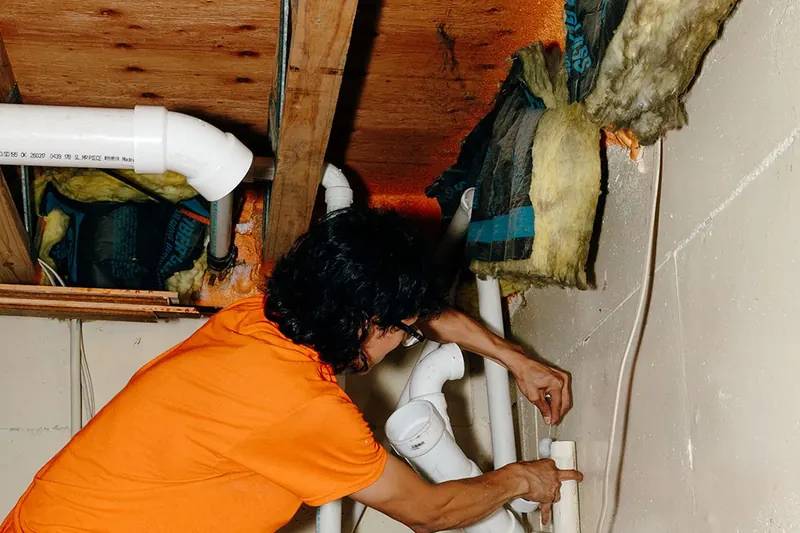
We start with a walk-through. We look at the main line, the water heater, how the pipes run through the basement or crawlspace, and where they go up to each bathroom and the kitchen. Then we plan the new layout.
Most repipes use PEX, a flexible plastic tubing that resists scale and freezing better than galvanized and needs fewer fittings. Copper is an option too. We’ll explain both.
In homes with a basement or crawlspace, much of the work happens from below. Getting to upstairs bathrooms usually means a few small openings in walls or ceilings. We plan routes to keep those to a minimum and tell you where they’ll be before we start. Plaster walls in older homes take some extra care, and we account for that.
We replace the supply lines to each fixture, put in new shutoff valves, and test the system before we close anything up. Most whole-home repipes take a few days. We restore water at the end of each day whenever we can.
Benefits You’ll Notice After Repiping
- Better water pressure throughout the house
- Clear water instead of rust after it sits
- No more surprise leaks at old joints
- New shutoff valves that actually turn
- Lines routed away from cold outside walls where they used to freeze
Partial Repiping vs. a Whole-Home Repipe
Not every house needs every line replaced at once. If one section is failing, say the run to the kitchen or the lines in the crawlspace, we can replace that first. We’ll give you an honest read on whether a partial repipe is a good idea or if you’d be back for the rest soon.
Plumbing Services Related to Repiping
If your drain lines are as old as your water lines, consider drain replacement at the same time. Old pipes freezing every winter? See frozen pipe repair. After a repipe, a water softener helps protect the new lines and fixtures from hard water. See all plumbing services in Tipton and our specials. You get the price before any work starts, and if you have a written quote from another company, show it to us and we’ll match it.
We repipe homes in Tipton, Windfall, Sharpsville, Kempton, Goldsmith, Hobbs, Tetersburg, Groomsville, Ekin, Curtisville and Normanda.
Book Online or call (765) 450-9040.
Whole-Home Repiping FAQs in Tipton, IN
Look at the pipes in the basement or crawlspace. Galvanized pipe is dull gray steel with threaded fittings. A magnet will stick to it. Copper is reddish, and PEX is colored plastic tubing.
Most homes take a few days, depending on size, layout and wall access. We try to restore water at the end of each workday.
Some access is usually needed, especially for upstairs bathrooms. We plan routes to keep openings small and tell you where they’ll be before we start.
Both work well. PEX is flexible, resists freezing damage and scale, and needs fewer fittings. Copper is durable and traditional. We explain both and help you choose.
In most homes with old galvanized pipe, yes. New lines restore the full inside diameter that years of rust and scale had closed down.